息
Character Story & Explanation
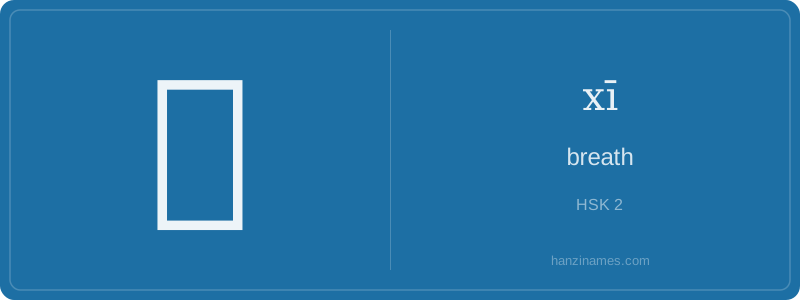
In modern Chinese, 息 is ubiquitous in compound words tied to information, rest, and finance—reflecting its semantic roots in 'breath' as both life-sustaining rhythm and momentary pause. It appears in HSK-2 vocabulary like 休息 (xiūxi, 'to rest'), 新闻 (xīnwén, 'news'—literally 'new information'), and 利息 (lìxī, 'interest'), where 'interest' metaphorically echoes 'the breath of capital'—a periodic, vital return. The idiom 息事宁人 (xī shì níng rén, 'to quell disputes to pacify people') dates to the Ming dynasty and remains common in mediation contexts.
The character’s form is well-documented: 自 (nose) + 心 (heart/mind), first appearing in seal script during the Qin dynasty (3rd c. BCE). It was never a pictograph of wind or steam; rather, it graphically encodes breath as an internal, conscious process—originating at the nose and registering in the heart-mind. No oracle-bone variant exists; its earliest attestation is in bronze inscriptions with this structure.
As an archaeologist sifting through bamboo slips from the Warring States period, I found 息 etched not as a static glyph—but as a living record of breath’s dual rhythm: inhalation and cessation. Its top half 自 (zì), originally a pictograph of a nose, anchors it in embodied physiology; the bottom 心 (xīn, 'heart/mind') reveals ancient Chinese cosmology—where breath was the vital bridge between body and spirit. This wasn’t metaphor; it was medical ontology.
Excavations at Mawangdui unearthed silk manuscripts (c. 168 BCE) where 息 appears in therapeutic contexts—'regulating the breath' (调息, tiáoxī) to harmonize qi. Here, 息 isn’t passive air—it’s *intentional respiration*, a disciplined act linking Daoist self-cultivation and early Chinese medicine. The character thus emerged not from abstract philosophy, but from clinical practice inscribed on silk and bone.
Later Han dynasty dictionaries like the Shuōwén Jiězì (121 CE) formally defined 息 as 'to rest; to cease; to breathe'—confirming its semantic expansion from physiological breath to conceptual pause and renewal. This evolution mirrors how imperial bureaucrats used 息 to denote 'suspended duty' or 'tax relief'—breath as socio-political reprieve. Every stroke carries stratified meaning: biological, spiritual, administrative—layered like sediment in a Zhou dynasty well.
Example Sentences
Common Compounds
Similar Characters — Don't Mix These Up
Your First Step into Chinese Culture: Get a Chinese Name
Every journey into Chinese begins with a name. Use our free Chinese name generator to create a meaningful, personalized Chinese name that fits you perfectly.
Get My Chinese Name →