思
Character Story & Explanation
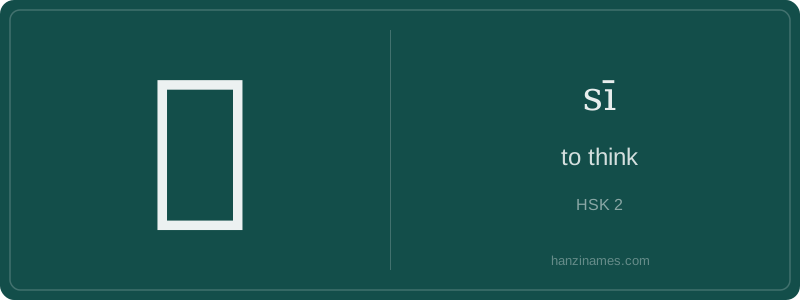
思 is ubiquitous in modern Chinese: it anchors HSK 2 vocabulary, appears in classroom chants ('I think, therefore I learn'), and features in formal writing, literature, and daily speech — e.g., 我在想 (wǒ zài xiǎng, 'I’m thinking') or 你有没有想过? (nǐ yǒu méiyǒu xiǎngguo?, 'Have you ever considered?'). It’s essential in idioms like 三思而行 (sān sī ér xíng, 'think thrice before acting'), cited since the Analects (15.10). The Ministry of Education’s 2021 language usage report lists 思 among the top 50 most frequent verbs in middle-school textbooks.
The upper component of 思 (originally 司) is not a pictograph but a phonetic loan. Oracle bone script shows no direct pictorial 'thought' glyph; instead, early forms combine 心 with phonetic elements. So rather than imagining ancient brains, consider today’s student pausing mid-sentence, finger tapping temple — that silent, focused moment is 思 in action.
As a linguistic detective, I begin with the modern form of 思: nine strokes, heart radical (心) at the bottom, and 'field' (田) crowned by 'together' (囟) above — though this upper part is now purely phonetic. Historically, it’s not a pictograph of thinking but a phono-semantic compound: the lower 心 signals meaning (mental activity), while the upper part, derived from 司 (sī, 'to manage'), provided sound. This structure reflects ancient Chinese logic: thought is an internal, heart-centered act of governance over ideas.
The character first appears in bronze inscriptions of the Western Zhou (c. 1046–771 BCE), already with its core semantic-phonetic layout. By the Warring States period, it was standard in bamboo-slip texts like the Guodian Chu Slips — used for 'consideration', 'remembrance', and 'intention'. Its stability across 3,000 years underscores how central 'thinking' was to early Chinese ethics: Confucius repeatedly linked 思 with learning (e.g., Analects 2.15: 'Learning without thinking leads to confusion').
Unlike English ‘think’, which emphasizes cognition, 思 carries affective weight — it implies earnest, reflective, often emotional mental engagement. That’s why it appears in words like 思念 (sīniàn, 'yearning') and 深思 (shēnsī, 'profound reflection'). Even today, calligraphers stress the heart radical’s centrality: the final dot of 心 must be placed deliberately — as if punctuating a thought with feeling. This isn’t just grammar; it’s embodied philosophy.
Example Sentences
Common Compounds
Similar Characters — Don't Mix These Up
Your First Step into Chinese Culture: Get a Chinese Name
Every journey into Chinese begins with a name. Use our free Chinese name generator to create a meaningful, personalized Chinese name that fits you perfectly.
Get My Chinese Name →