贿
Character Story & Explanation
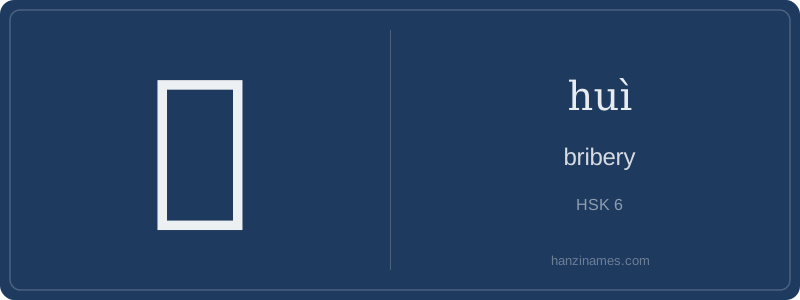
In contemporary China, 贿 appears most commonly in official anti-corruption discourse. Since 2013, over 4 million Party members have been disciplined for violations involving 贿, according to CCDI annual reports. Key phrases include 受贿罪 (shòu huì zuì, 'crime of accepting bribes') — a criminal charge under Article 385 of China’s Criminal Law — and 行贿人 (xíng huì rén, 'briber'). Media coverage of high-profile cases (e.g., former Chongqing official Sun Zhengcai, sentenced in 2018 for accepting ¥170M in bribes) consistently uses this character in headlines and verdict summaries.
The character’s structure is well-documented: left-side 贝 (bèi) is the ‘wealth’ radical, reflecting its origin in ancient shell currency; right-side 有 (yǒu) is a phonetic-semantic compound meaning 'to have'. No oracle bone or bronze script forms survive for 贿 specifically, but its earliest attestation is in Warring States bamboo slips (4th c. BCE), where it denoted improper gift-giving to officials — confirming its long-standing association with abuse of power.
The character 贿 (huì) carries strong negative connotations in Chinese society, signifying the illegal exchange of money or favors to influence official conduct. Its presence instantly evokes corruption investigations, anti-graft campaigns, and public distrust in institutions. Unlike neutral financial terms, 贿 is almost exclusively used in legal, journalistic, or moral contexts — never in casual or positive speech. It appears frequently in headlines from China’s Central Commission for Discipline Inspection (CCDI), underscoring its role in state-led integrity efforts.
Etymologically, 贿 belongs to the 贝 (bèi) radical — historically representing cowrie shells, the earliest form of currency in ancient China. This root signals its monetary core: bribery is fundamentally about illicit payment. The right component, 有 (yǒu, 'to have'), reinforces possession — implying something improperly acquired or exchanged. Together, they visually encode 'having wealth used corruptly', not just 'giving money'.
At HSK Level 6, 贿 marks advanced sociopolitical literacy. Learners encounter it not in dialogues but in formal texts: court verdicts, policy white papers, or investigative reports. Mastery requires understanding nuanced collocations like 受贿 (shòu huì, 'to accept bribes') versus 行贿 (xíng huì, 'to offer bribes') — distinctions critical in legal Chinese. Its rarity in spoken language reflects China’s cultural aversion to overt discussion of corruption, making written recognition more vital than oral use.
Example Sentences
Common Compounds
Similar Characters — Don't Mix These Up
Your First Step into Chinese Culture: Get a Chinese Name
Every journey into Chinese begins with a name. Use our free Chinese name generator to create a meaningful, personalized Chinese name that fits you perfectly.
Get My Chinese Name →