赌
Character Story & Explanation
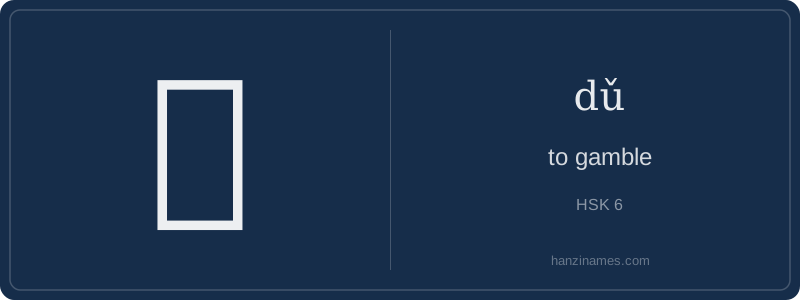
In contemporary China, 赌 is overwhelmingly used in negative, regulatory, or cautionary contexts due to strict anti-gambling laws — legal gambling exists only in Macau and state-run lotteries. Common phrases include 赌博 (dǔbó, 'gambling'), 赌徒 (dǔtú, 'gambler'), and the idiom 赌气 (dǔqì, 'to act out of spite'). Media reports consistently pair 赌 with verbs like 禁止 (jìnzhǐ, 'ban') or 治理 (zhìlǐ, 'govern'), reflecting its socially sensitive status.
The character’s written form dates to the Qin–Han period (3rd c. BCE–3rd c. CE) as a phono-semantic compound: left-side 贝 ('shell money') denotes monetary activity; right-side 堵 was borrowed solely for sound (dǔ). No oracle-bone or bronze inscriptions of 赌 exist — it emerged later as gambling practices formalized in commercial society.
The character 赌 (dǔ) embodies the high-stakes tension of risk and reward — a concept deeply woven into Chinese social history, from imperial-era mahjong parlors to modern online gaming regulations. Its radical 贝 (bèi), meaning 'shell' — an ancient form of currency — visually roots gambling in economic exchange, not mere chance. This etymological anchor reminds learners that betting in Chinese culture is historically tied to value, transaction, and consequence.
At HSK Level 6, 赌 signals advanced lexical awareness: it appears in formal discourse on law, finance, and ethics — not just slang. Learners encounter it in news headlines about anti-gambling campaigns or financial ‘speculation’ (投机 vs. 赌博), where nuance matters. Misusing it as a casual synonym for ‘trying’ (e.g., confusing 赌 with 猜 or 试) risks sounding reckless or legally insensitive.
Stroke order matters: the 12 strokes begin with the ‘shell’ radical on the left (贝), followed by the right component 堵 (dǔ) — a phonetic hint, not a semantic one. Though 堵 means ‘to block’, here it only guides pronunciation. This ‘radical-phonetic’ structure is typical of ~80% of Chinese characters, making 赌 a textbook example for understanding how meaning and sound coexist visually.
Example Sentences
Common Compounds
Similar Characters — Don't Mix These Up
Your First Step into Chinese Culture: Get a Chinese Name
Every journey into Chinese begins with a name. Use our free Chinese name generator to create a meaningful, personalized Chinese name that fits you perfectly.
Get My Chinese Name →