趴
Character Story & Explanation
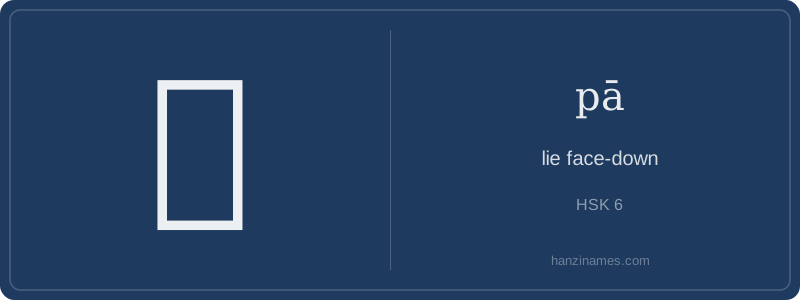
In modern Mandarin, 趴 is overwhelmingly used in informal, descriptive contexts—especially in education, childcare, and medical settings—to denote intentional or exhausted prone positioning. It appears in HSK 6 vocabulary lists for its nuance: unlike 平躺 (to lie supine) or 侧卧 (to lie on one’s side), 趴 exclusively means face-down. It features in the common phrase 趴着睡觉 (pā zhe shuì jiào, 'sleeping face-down'), frequently documented in pediatric health advisories warning against infant SIDS risk.
The character is not pictographic nor ancient—it first appeared in printed vernacular texts circa 17th century. Its structure is phono-semantic: 足 (foot radical, suggesting bodily position/action) + 八 (phonetic, approximating pā). No oracle bone or bronze script forms exist. Today, Chinese students learn it in primary school when describing classroom behavior ('别趴在桌上!' — 'Don’t slump over your desk!').
As an archaeologist sifting through layers of linguistic sediment, I find 趴 not in oracle-bone inscriptions—where it is absent—but in the late imperial and Republican-era texts where colloquial verbs began crystallizing in print. Its emergence reflects a shift: from classical, posture-agnostic verbs like 卧 (to lie) to vernacular specificity. The character’s construction—foot radical 足 paired with 八 (bā), a phonetic component—signals bodily action grounded in movement or stance, not static rest.
This character didn’t spring from ritual bronze inscriptions but from lived physicality: children napping on desks, laborers resting mid-task, soldiers taking cover. Its nine-stroke form stabilized during the Ming–Qing transition, appearing reliably in vernacular fiction like *The Scholars* (1750) to depict slumped, weary, or casually prone postures—never formal or ceremonial. It carries no moral weight, unlike 卧 (which can imply dignity or death), making it linguistically ‘low’ but semantically precise.
The foot radical 足 here is revelatory—not indicating locomotion, but anchoring: the body’s base pressed flat to earth or surface. Like unearthing a Ming-dynasty inkstone worn smooth by centuries of elbows, 趫 captures habitual human contact with horizontal planes. Its phonetic 八 once approximated *pā* in Middle Chinese, though pronunciation shifted; yet the visual logic endured: two diverging strokes mirroring splayed arms or legs, grounding the character in embodied geometry rather than abstract ideation.
Example Sentences
Common Compounds
Similar Characters — Don't Mix These Up
Your First Step into Chinese Culture: Get a Chinese Name
Every journey into Chinese begins with a name. Use our free Chinese name generator to create a meaningful, personalized Chinese name that fits you perfectly.
Get My Chinese Name →