跌
Character Story & Explanation
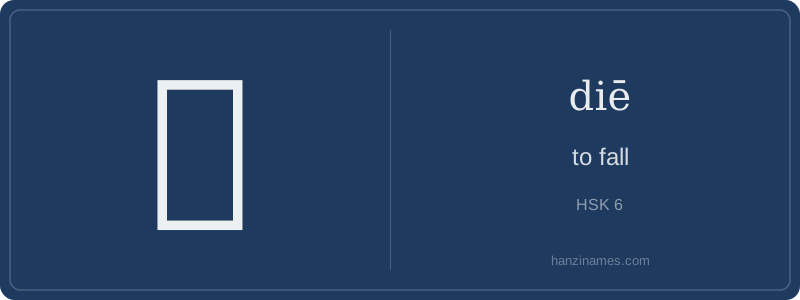
In modern Chinese daily life, 跌 is ubiquitous in health, finance, and weather reporting. Medical professionals use ‘跌倒风险评估’ (diēdǎo fēngxiǎn pínggū, ‘fall risk assessment’)—a standardized tool in China’s national elderly health management program since 2019. Financial headlines frequently feature ‘跌幅’ (diēfú, ‘decline幅度’) and ‘跌破’ (diēpò, ‘fall below [a threshold]’), especially during market volatility like the 2015–2016 A-share corrections. The idiom ‘一落千丈’ (yī luò qiān zhàng), though using 落, often appears alongside 跌 in comparative analysis of steep declines.
The character 跌 first appeared in seal script during the Warring States period (475–221 BCE). Its structure is clearly semantic-phonetic: left radical 足 indicates leg/foot-related action; right component 失 (originally picturing a hand dropping an object) provides phonetic approximation and semantic reinforcement—‘losing one’s footing’. No oracle bone form survives, but early bronze inscriptions confirm its use for ‘stumble’ or ‘descend abruptly’.
Imagine a rainy afternoon in Beijing’s historic Hutong alleys—slippery gray bricks glisten under drizzle. An elderly man in a blue cotton jacket steps off his bicycle, misjudges the wet stone, and suddenly diē—a sharp, uncontrolled fall backward onto the cobblestones. His cane clatters; a startled pigeon flutters away. The word 跌 captures that precise moment: not just gravity acting, but loss of balance, sudden descent, often with vulnerability or consequence.
This character carries physical and metaphorical weight. Beyond literal falls, 跌 signals decline—stock prices diē, morale diē, confidence diē. In financial news on CCTV or WeChat finance groups, you’ll hear ‘股市大跌’ (gǔshì dà diē)—‘the stock market plunged’—where 跌 conveys rapid, unsettling downward motion, never gentle or gradual.
The radical 足 (foot) anchors its meaning in bodily movement: falling begins with the feet losing purchase. Its right side 失 (shī, ‘to lose’) reinforces the idea of loss—of control, stability, or position. Together, they form a semantic-phonetic compound where 失 hints at both sound (historically close to diē) and meaning. It’s a character deeply embedded in China’s linguistic landscape—from hospital reports noting ‘跌倒’ (diēdǎo, ‘fall down’) in geriatric care guidelines to state media describing economic corrections as ‘温和下跌’ (wēnhé xiàdiē, ‘moderate decline’).
Example Sentences
Common Compounds
Similar Characters — Don't Mix These Up
Your First Step into Chinese Culture: Get a Chinese Name
Every journey into Chinese begins with a name. Use our free Chinese name generator to create a meaningful, personalized Chinese name that fits you perfectly.
Get My Chinese Name →