踊
Character Story & Explanation
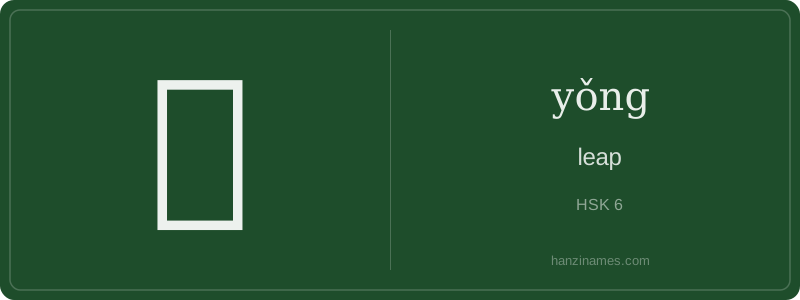
踊 is most commonly encountered today in formal or literary contexts—especially in idioms and news reporting. The compound 欢呼雀跃 (huānhū quèyuè, 'cheering and sparrow-leaping') remains widely used in state media to depict mass jubilation (e.g., Olympic victories or scientific achievements). Historically, it appears in the *Zuo Zhuan* (c. 4th century BCE) describing ritual dances and in Tang poetry referencing celebratory leaps during festivals. It’s rare in casual speech but stable in written registers.
The character evolved from seal script, where 足 (foot) clearly forms the left-hand radical, and the right side derives from 勇 (courage), serving as both phonetic and semantic reinforcement. No oracle bone form survives, but bronze inscriptions confirm its use by the Warring States period to denote ritualized, upright motion—not random jumping, but intentional, upright kinetic expression tied to emotion or ceremony.
The Chinese character 踊 (yǒng) conveys the physical act of leaping or jumping upward with energy and intention—not merely hopping, but a vigorous, often expressive, vertical movement. Its radical 足 (foot) anchors it in bodily action, while the phonetic component 勇 (yǒng, 'courage') hints at emotional impetus: leaps are rarely neutral; they signal excitement, protest, or transcendence. This dual grounding in physiology and psychology makes 踊 richer than English 'leap', which lacks built-in moral or emotional resonance.
In Western contexts, 'leap' appears in metaphors like 'leap of faith' (Kierkegaard) or 'leap year', where it signifies abrupt transition or irregularity—often abstract or calendrical. By contrast, 踊 retains strong corporeal immediacy: classical texts describe dancers 踊ing in ritual rites, and modern media report crowds 踊ing in celebration or anger. Unlike Western 'dance' (ballet, tap), which may emphasize grace or technique, 踊 foregrounds spontaneity and collective kinetic release.
Culturally, 踊 carries layered valence: in Confucian historiography, it could denote improper exuberance (e.g., 'leaping in grief' violating ritual restraint), while in Daoist or folk contexts, it symbolizes liberated spirit—echoing shamanic trance-jumping across cultures. Yet unlike Greek choros or West African dance-as-ancestral-communion, 踊 rarely implies divine possession; instead, it reflects human agency channeled through the body. This makes it a precise lens into how Chinese thought links movement, morality, and social order.
Example Sentences
Common Compounds
Similar Characters — Don't Mix These Up
Your First Step into Chinese Culture: Get a Chinese Name
Every journey into Chinese begins with a name. Use our free Chinese name generator to create a meaningful, personalized Chinese name that fits you perfectly.
Get My Chinese Name →