辕
Character Story & Explanation
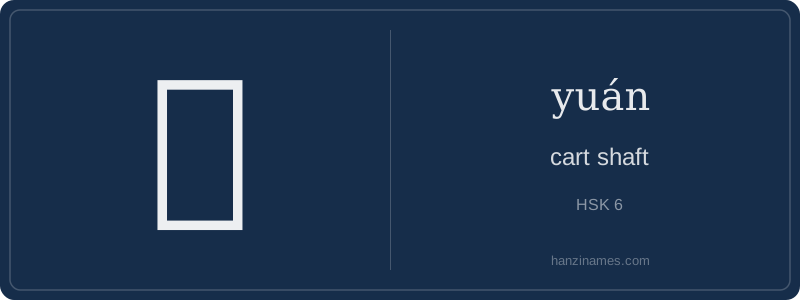
In modern usage, 辕 appears almost exclusively in literary, historical, or idiomatic contexts—not daily speech. It features in the idiom ‘南辕北辙’ (nán yuán běi zhé), meaning 'heading south while aiming north'—a classic paradox illustrating self-defeating action, famously recorded in the *Stratagems of the Warring States*. Historically, it was standard terminology in pre-Qin vehicle treatises and Han dynasty administrative records concerning imperial transport.
The character’s form is not pictographic but phono-semantic: 车 (radical, meaning 'vehicle') + 袁 (phonetic, yuán). No oracle bone or bronze script form survives for 辕 itself—it first appears in seal script (c. 3rd century BCE), confirming its origin in the chariot-centric Warring States period. Today, Chinese learners encounter it primarily in HSK 6 reading passages about ancient logistics or classical allusions.
Unearthing this character feels like brushing dust from a bronze chariot fitting at a Zhou dynasty tomb site—what emerges is not just metal, but meaning anchored in motion. 辕 (yuán) originally denoted the central draft pole extending forward from a two-wheeled cart’s axle, to which horses were harnessed. Its form preserves functional logic: the left-side radical 车 (chē, 'cart') declares domain; the right-side component 袁 (yuán) provides phonetic guidance and, in early inscriptions, subtly echoes the pole’s elongated, unbroken profile.
This shaft was no mere structural element—it dictated control, balance, and military coordination. Ancient texts like the *Zuo Zhuan* record commanders standing on the yuán during parades to survey troops, transforming the pole into a symbol of authority. The character thus evolved from engineering term to metaphor: ‘grasping the yuán’ meant assuming command, much as a helmsman grips the tiller. Its semantic weight grew alongside China’s chariot-based warfare and ritual processions.
Though wheeled transport faded, 辕 endured in language like sedimentary strata. It appears in classical poetry describing abandoned battlefields—‘broken yuán lying in weeds’—evoking collapse of order. In administrative texts, it anchored bureaucratic metaphors: the ‘yuán of governance’ implied foundational policy direction. Today, its rarity reflects technological obsolescence, yet its presence in idioms and historical compounds ensures continuity—not as artifact, but as linguistic fossil revealing how movement, power, and structure were once inseparable.
Example Sentences
Common Compounds
Similar Characters — Don't Mix These Up
Your First Step into Chinese Culture: Get a Chinese Name
Every journey into Chinese begins with a name. Use our free Chinese name generator to create a meaningful, personalized Chinese name that fits you perfectly.
Get My Chinese Name →