辙
Character Story & Explanation
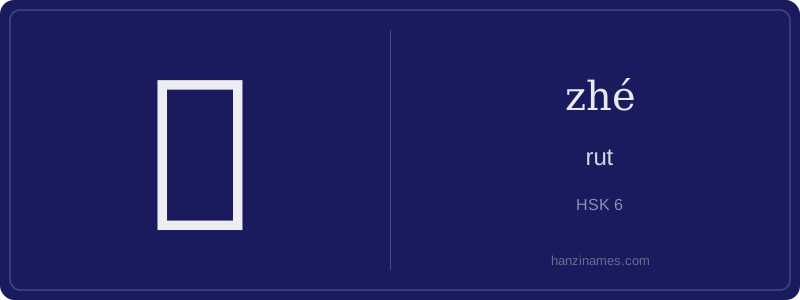
In daily life, 辙 most commonly appears in idioms and formal registers. The idiom '重蹈覆辙' (chóng dǎo fù zhé, 'to tread again the same rut') is widely used in news, education, and policy documents to warn against repeating past mistakes—e.g., economic missteps or diplomatic blunders. It’s cited in official Xinhua News Agency reports and Ministry of Education guidelines. Historically, the term appears in the 3rd-century BCE text *Xunzi*, criticizing rulers who blindly follow outdated methods without adapting to changing conditions.
The character’s form is not pictographic but phono-semantic: left radical 车 ('cart/vehicle') signals meaning; right component 及 (jí, 'to reach') originally served as a phonetic clue (Old Chinese *ɡrəp), though pronunciation shifted over millennia. No oracle-bone or bronze inscriptions of 辙 survive—but its earliest attested use is in Han dynasty bamboo slips discussing road maintenance and axle standards.
The Chinese character 辙 (zhé) literally denotes the groove or track left by a wheel on a road—what we call a 'rut' in English. Historically, it evokes images of ancient cart traffic on earthen roads, where repeated passage carved permanent impressions. In modern usage, it extends metaphorically to entrenched patterns of thought, behavior, or policy—often with a connotation of inflexibility or stagnation. Its radical 车 (chē, 'vehicle') anchors its concrete origin, while the phonetic component 辶 (chuò, 'to walk') is absent; instead, the right side 辶 is actually a misreading—the true phonetic is 徒 (tú), though this has evolved orthographically over time.
Comparatively, Western equivalents like 'rut' (English), 'ornière' (French), or 'Fahrrinne' (German) carry similar dual meanings: literal wheel tracks and figurative mental or systemic grooves. Yet 辙 carries stronger classical resonance—it appears in Confucian and Daoist texts warning against rigid adherence to precedent. Unlike English ‘rut’, which often implies negativity, 辙 can be neutral or even positive in technical contexts (e.g., opera singing 'rhythmic tracks'), reflecting China’s longstanding emphasis on disciplined tradition within artistic and bureaucratic systems.
This duality mirrors broader cultural attitudes toward continuity and change. While Western individualism may frame 'getting out of a rut' as liberation, Chinese discourse often values 'following the correct 辙'—i.e., aligning with time-tested principles (e.g., Confucian rites or state policy frameworks). Thus, 辙 isn’t just about constraint; it signifies legitimacy through proven paths. Its HSK Level 6 status reflects this layered abstraction—learners must grasp not only the physical image but also how it encodes authority, precedent, and rhetorical weight in formal speech and writing.
Example Sentences
Common Compounds
Similar Characters — Don't Mix These Up
Your First Step into Chinese Culture: Get a Chinese Name
Every journey into Chinese begins with a name. Use our free Chinese name generator to create a meaningful, personalized Chinese name that fits you perfectly.
Get My Chinese Name →