轰
Character Story & Explanation
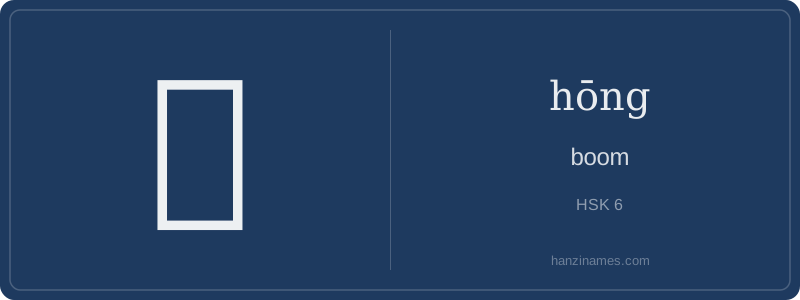
轟 is widely used in modern Chinese for both literal and figurative explosions: news headlines say ‘a scandal轰动全国’ (caused nationwide sensation), military texts use 轰炸 (hōngzhà, bombing), and colloquially, people say ‘他被轰下台’ (he was booted from office—literally ‘hurled down the stage’). It appears in the idiom 轰轰烈烈 (hōnghōnɡlièliè), meaning ‘with great fanfare and momentum’, often describing revolutions or large-scale campaigns documented since the 1950s.
The character is a phono-semantic compound: the left radical 车 (chē, ‘vehicle’) hints at movement/force, while the right component 咼 (gāo, archaic for ‘high’ or ‘lofty’) originally contributed sound. Though not pictographic, its structure reflects early association of explosive force with vehicular power—documented in Shuōwén Jiězì (121 CE) as ‘sound of many carts moving together’, evolving into its modern onomatopoeic sense.
The character 轰 (hōng) embodies the Chinese worldview’s dynamic interplay between sound, force, and consequence. Unlike Western notions of explosion as purely destructive, 轰 conveys resonance—both physical and social. Its onomatopoeic origin mirrors how traditional Chinese thought values auditory symbolism: a loud, reverberating sound signals sudden change, not just chaos, but the necessary rupture before renewal—echoing Daoist ideas of transformation through imbalance.
In classical and modern usage, 轰 carries moral weight: to ‘bombard’ with criticism (轰击) or ‘overwhelm’ with praise (轰动) reflects Confucian attention to impact and social ripple effects. The character rarely stands alone; it appears in contexts where action reverberates outward—linking individual deed to collective perception, underscoring harmony as an achieved resonance, not static silence.
This worldview treats intensity not as aberration but as rhythm: thunder (雷声轰鸣) is nature’s warning and cleansing; a ‘thunderous’ applause (掌声轰鸣) affirms communal alignment. Even in digital life, 轰 is repurposed—‘going viral’ is 轰动一时—showing how ancient phonetic imagery adapts to modern attention economies, always preserving its core idea: true impact is measured not by force alone, but by how far and how meaningfully the sound travels.
Example Sentences
Common Compounds
Similar Characters — Don't Mix These Up
Your First Step into Chinese Culture: Get a Chinese Name
Every journey into Chinese begins with a name. Use our free Chinese name generator to create a meaningful, personalized Chinese name that fits you perfectly.
Get My Chinese Name →