迸
Character Story & Explanation
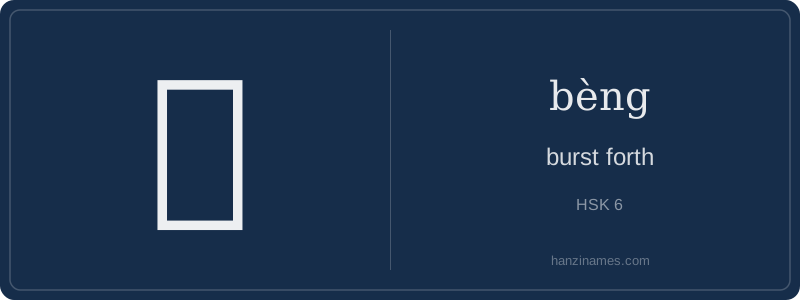
迸 is commonly used in modern written Chinese — especially in journalism, literary descriptions, and official reports — to convey sudden, energetic emergence. You’ll find it in phrases like 迸发 (bèngfā, 'to burst forth/flare up'), frequently in contexts like 'innovation bursts forth' or 'emotions burst forth'. It appears in the idiom 火星四迸 (huǒxīng sì bèng, 'sparks fly in all directions'), describing chaotic intensity. Historically, it’s documented in Ming- and Qing-dynasty texts describing fireworks, metalworking, and emotional outbursts.
The character combines 辶 (chuò, 'walk/direction') on the right and 并 (bìng, 'together/merge') on the left — not a pictograph, but a phono-semantic compound. 并 provides sound (bìng → bèng) and hints at convergence before release; 辶 suggests outward motion. No oracle-bone form survives, but its structure reflects its meaning: unified energy moving outward explosively.
Hi students! Let’s learn 迸 (bèng), a vivid verb meaning 'to burst forth' — like sparks flying, tears bursting out, or energy suddenly erupting. It’s not just about physical explosion; it conveys sudden, forceful emergence of something intangible too: emotions, ideas, or sounds. Though it looks complex with its 辶 (walk) radical, remember that this radical often hints at movement or direction — fitting for something that bursts *outward* and *forward*.
This character appears in formal writing, literature, and media — less in casual speech — so it’s especially useful for advanced learners aiming for expressive fluency. Its pronunciation bèng is a fourth-tone falling sound, similar to saying 'beng!' sharply — which actually mimics the abruptness it describes. Practice saying it with energy to feel its meaning!
Don’t confuse 迸 with simpler verbs like 出 (chū, 'to go out') or 爆 (bào, 'to explode'). 迸 emphasizes *sudden, dynamic release*, often with visible particles (sparks, droplets) or intense emotion. Think of it as the Chinese equivalent of 'erupt', 'gush', or 'flash out' — poetic but precise. Mastering it adds nuance when describing dramatic moments in stories or reports.
Example Sentences
Common Compounds
Similar Characters — Don't Mix These Up
Your First Step into Chinese Culture: Get a Chinese Name
Every journey into Chinese begins with a name. Use our free Chinese name generator to create a meaningful, personalized Chinese name that fits you perfectly.
Get My Chinese Name →