逆
Character Story & Explanation
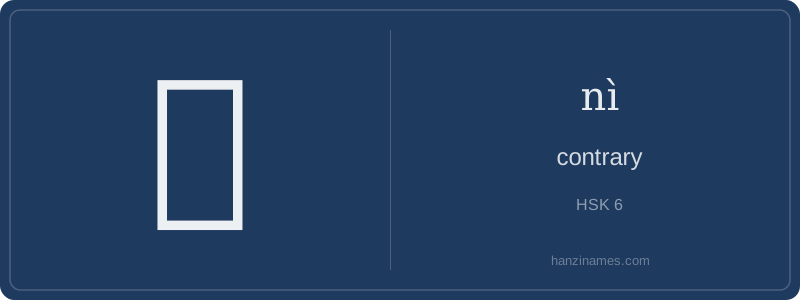
In modern Chinese, 逆 most commonly appears in formal, literary, or critical contexts — never in casual speech alone. It’s central to the idiom 逆来顺受 (nì lái shùn shòu), meaning 'to accept adversity passively', widely cited in sociological studies of traditional Chinese resilience. Historically, it appears in classical texts like the Zuo Zhuan describing 'rebellious vassals' (逆臣) and in imperial edicts condemning 'treasonous acts' (大逆).
The character’s origin is documented in early seal script: it combines 辶 (movement) with 卩 (a ceremonial jade tablet symbolizing authority). Thus, 逆 literally signifies 'moving against the mandate' — not abstract 'contrariness', but concrete resistance to legitimate power. This legal-moral nuance persists: modern usage still carries weighty connotations of moral or systemic opposition.
Our detective begins at the crime scene: the character 逆. First, we note its radical — 辶 (chuò), the ‘walking’ or ‘movement’ radical — suggesting motion, direction, or journey. The right side, 卩 (jié), is an ancient seal or tally mark, historically linked to authority, control, or official sanction. Together, they imply movement *against* sanctioned order — a visual metaphor for opposition or reversal.
Tracing its evolution through seal script (c. 3rd century BCE), 逆 appears as a clear compound: the walking radical plus a stylized figure kneeling or submitting — later simplified to 卩. This reinforces its core semantic field: resisting expected direction, whether physical (going upstream), social (disobeying hierarchy), or cosmic (defying fate). No oracle bone form survives, but early bronze inscriptions use it in contexts of rebellion and defiance.
The character’s structure tells a consistent story: motion + constraint = counter-motion. Its nine-stroke composition is economical yet precise — three strokes for the radical’s ‘walk’ component (辶), six for the phonetic-semantic 卩 + 丿 + 一. Even today, every stroke reinforces its meaning: you cannot write 逆 without drawing a path that turns back — a literal hand-drawn act of reversal.
Example Sentences
Common Compounds
Similar Characters — Don't Mix These Up
Your First Step into Chinese Culture: Get a Chinese Name
Every journey into Chinese begins with a name. Use our free Chinese name generator to create a meaningful, personalized Chinese name that fits you perfectly.
Get My Chinese Name →