逝
Character Story & Explanation
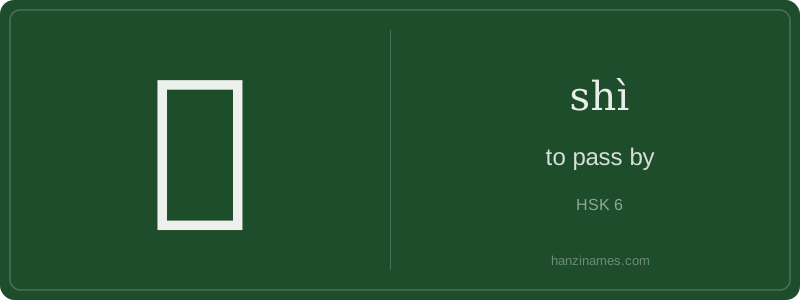
In daily life, 逝 appears most formally: in obituaries (逝世 shìshì, 'passed away'), memorial inscriptions, and literary writing. It’s central to the famous Analects quote '逝者如斯夫,不舍昼夜' (The Master stood by a river and said: 'What passes away is, perhaps, like this — never ceasing day or night'), recorded in the 5th century BCE. This phrase remains widely quoted in education and media to reflect on time’s irreversibility.
The character evolved from seal script (c. 3rd century BCE), where it clearly combines 辶 ('walking') and 折 (zhé, 'to break/bend', suggesting irrevocability). No oracle bone form survives, but early forms consistently emphasize irreversible motion — not physical travel, but the unstoppable flow of time or life. Today, Chinese people use 逝 almost exclusively in written, respectful contexts — never in slang or texting.
Hi students! Let’s learn 逝 (shì), a beautiful but solemn character meaning 'to pass by' — especially for time, life, or opportunities that slip away. It’s not used for everyday motion like walking; instead, it carries poetic weight, often appearing in literature, elegies, or philosophical reflections. Notice its radical 辶 (chuò), the 'walking' radical — a clue that this character is about movement, but abstract and irreversible movement, like time flowing forward.
This character appears only at HSK Level 6, so you’ll mostly encounter it in mature, literary contexts — not casual speech. It’s rarely used alone; instead, it partners with nouns like 岁月 (suìyuè, 'years'), 青春 (qīngchūn, 'youth'), or 光阴 (guāngyīn, 'time') to express gentle sorrow or quiet acceptance of impermanence. Think of it as the Chinese linguistic equivalent of 'fleeting' or 'gone by' — respectful, elegant, and deeply cultural.
Don’t confuse 逝 with common verbs like 走 (zǒu, 'to walk/go') or 过 (guò, 'to pass'). 逝 is formal and final — it implies an end, not just transition. You’ll see it on tombstones (如‘先父某某某之墓,逝于2020年’), in classical poetry (e.g., Confucius’ famous line ‘逝者如斯夫’), and in modern essays about memory or loss. Mastering it helps you read high-level texts and understand how Chinese thinkers contemplate time and mortality.
Example Sentences
Common Compounds
Similar Characters — Don't Mix These Up
Your First Step into Chinese Culture: Get a Chinese Name
Every journey into Chinese begins with a name. Use our free Chinese name generator to create a meaningful, personalized Chinese name that fits you perfectly.
Get My Chinese Name →