遏
Character Story & Explanation
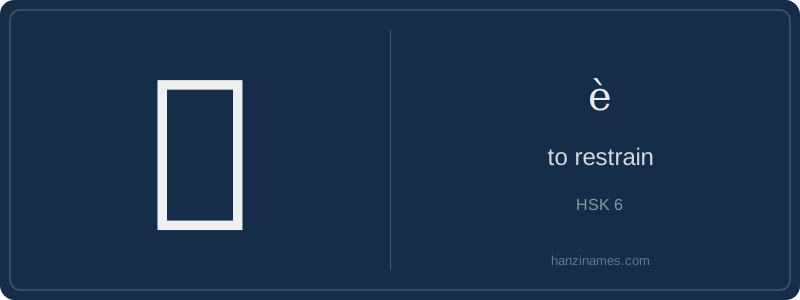
遏 is most commonly encountered in formal compounds like 遏制 (èzhì, 'to curb/restrain') — widely used in Chinese media and policy discourse, e.g., '遏制通胀' (curb inflation) or '遏制疫情蔓延' (halt the spread of an epidemic). It appears in the famous idiom 遏恶扬善 (è è yáng shàn), meaning 'suppress evil and promote goodness', cited in Song dynasty Confucian texts and still invoked in ethics education today.
Historically, 遏 first appeared in bronze inscriptions and the Classic of Poetry (Shījīng), where it described stopping floods or quelling rebellions. Its structure combines 辶 (movement) and 曷 (a phonetic with interrogative force), reflecting its core idea: *intervening decisively to halt undesirable motion or behavior*. No oracle-bone origin is confirmed, but its usage since the Warring States period is well-documented in excavated bamboo slips.
Hi students! Let’s learn 遏 (è), a formal, literary character meaning 'to restrain', 'to suppress', or 'to halt forcefully'. It’s not used in casual speech — you won’t hear it in coffee-shop chats — but appears often in written Chinese: news reports, official documents, historical texts, and classical poetry. Its tone is serious and authoritative, like a judge issuing an order or a government announcement stopping harmful activity.
The character has the ‘walking’ radical 辶 (chuò) on the right — hinting at movement being *stopped* — and the phonetic component 曷 (hé) on the left, which also subtly contributes meaning: 曷 originally meant 'how?' or 'why not?', suggesting rhetorical urgency — as if asking, 'How can this continue?' That nuance of moral or practical imperative is embedded in 遏.
Though it’s HSK Level 6 (advanced), don’t be intimidated! Think of 遏 as the 'strong stop' — stronger than 止 (zhǐ, 'to stop') and more deliberate than 阻 (zǔ, 'to obstruct'). It implies active, often institutional, intervention: halting a disease outbreak, suppressing false information, or restraining unchecked power. Mastering it helps you read high-level Chinese with precision and grasp subtle tones of authority and control.
Example Sentences
Common Compounds
Similar Characters — Don't Mix These Up
Your First Step into Chinese Culture: Get a Chinese Name
Every journey into Chinese begins with a name. Use our free Chinese name generator to create a meaningful, personalized Chinese name that fits you perfectly.
Get My Chinese Name →