遣
Character Story & Explanation
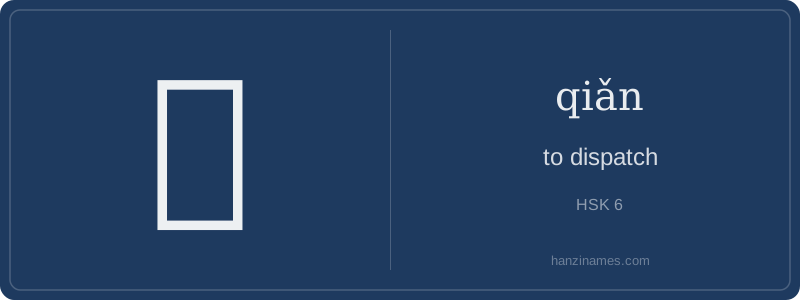
In daily life, 遣 most commonly appears in formal or bureaucratic contexts: government agencies 遣派 (qiǎnpài) officials abroad, companies 遣送 (qiǎnsòng) employees on assignment, or courts 遣返 (qiǎnfǎn) undocumented individuals. It’s central to idioms like ‘遣词造句’ (qiǎncí zàojù, ‘to choose words and construct sentences’), highlighting linguistic precision as deliberate craft. Historically, it appears in Tang dynasty poetry (e.g., Du Fu’s works) describing imperial envoys and military deployments.
The character’s seal script form (c. 3rd c. BCE) shows clear structure: the left side ‘厶’ + ‘卩’ (a kneeling figure with ritual insignia) over ‘辶’, indicating ‘a person formally sent forth under authority’. This reflects documented Zhou–Qin administrative practice—dispatching envoys required ritual certification, making 遣 a lexical artifact of early Chinese statecraft.
At its core, 遣 (qiǎn) embodies the Confucian-tinged ideal of purposeful action: not mere movement, but intentional, responsible transmission—of people, orders, or even emotions. Its radical 辶 (chuò), meaning 'to walk' or 'to move', frames the character as a journey with direction and duty. In classical thought, dispatching wasn’t just logistical—it implied moral weight: sending an envoy carried the state’s trust; sending off a scholar reflected scholarly lineage and expectation.
This character reveals how Chinese worldview intertwines agency with relational ethics. To 遣 is never neutral—it presupposes hierarchy (who sends? who is sent?), accountability (what mission must be fulfilled?), and continuity (the sender’s will extends through the dispatched). Even in modern usage, such as 遣返 (qiǎnfǎn, deportation), the sense of authoritative transfer remains embedded—not expulsion alone, but a formal, system-sanctioned repositioning.
Notably, 遣 also appears in literary and psychological contexts—e.g., 遣怀 (qiǎnhuái, ‘to dispel sorrow’)—where ‘sending’ becomes metaphorical: actively directing inner states rather than passively enduring them. This reflects a deeply pragmatic humanism: emotions, like envoys, can and should be *managed*, not merely felt. Thus, 遣 quietly encodes a worldview where intentionality, motion, and moral responsibility are inseparable.
Example Sentences
Common Compounds
Similar Characters — Don't Mix These Up
Your First Step into Chinese Culture: Get a Chinese Name
Every journey into Chinese begins with a name. Use our free Chinese name generator to create a meaningful, personalized Chinese name that fits you perfectly.
Get My Chinese Name →