锤
Character Story & Explanation
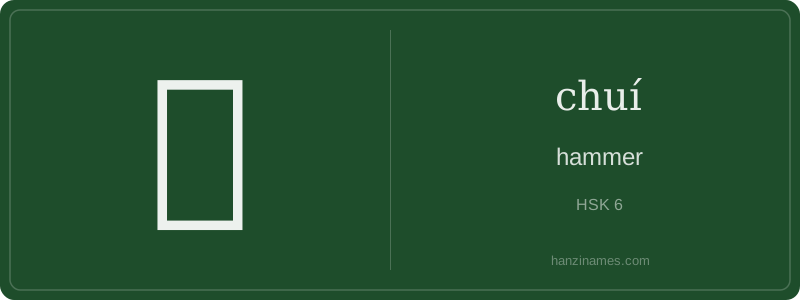
锤 is widely used in daily life—from construction sites ('打锤') to martial arts training ('锤法'), and especially in idioms like 千锤百炼 (qiān chuí bǎi liàn), meaning 'refined through countless hammerings', describing rigorous training or refinement. It appears in historical records such as the Song-era *Tiangong Kaiwu* (1637), which details iron forging techniques using hammers. Modern media frequently uses 锤 metaphorically: tech startups 'hammer out' solutions; teachers 'hammer home' concepts.
The character evolved from seal script, where 钅 (metal) was combined with 垂 (chuí, 'to hang down') as a phonetic loan. No pictographic origin survives—it’s a phono-semantic compound. Today, Chinese people commonly use 锤 in digital slang: '锤死' (chuí sǐ) means 'to strongly support/endorse', reflecting its connotation of emphatic, decisive action.
The character 锤 (chuí) embodies the Chinese worldview that tools are not merely functional but carry moral and philosophical weight. In classical thought, the hammer symbolizes disciplined action—striking with precision, not force—and reflects Confucian ideals of measured effort and rectitude. Its metal radical (钅) grounds it in material reality, while its phonetic component (垂) suggests gravity, humility, and downward intention—mirroring how wisdom must descend from theory into practice.
Historically, the hammer appears in Daoist alchemical texts as a metaphor for refining the self: just as metal is shaped through repeated, controlled blows, so too is character forged through persistent cultivation. This resonates with the broader Chinese belief that transformation requires both external discipline and internal alignment—never brute power alone.
In modern usage, 锤 extends beyond physical tools to signify rigorous intellectual or emotional labor—'hammering out' an idea, 'hammering home' a point. This semantic expansion reveals a cultural preference for active, embodied cognition: knowledge isn’t passively received but actively struck into being. The character thus becomes a quiet manifesto: truth takes shape only under deliberate, repeated pressure.
Example Sentences
Common Compounds
Similar Characters — Don't Mix These Up
Your First Step into Chinese Culture: Get a Chinese Name
Every journey into Chinese begins with a name. Use our free Chinese name generator to create a meaningful, personalized Chinese name that fits you perfectly.
Get My Chinese Name →