锲
Character Story & Explanation
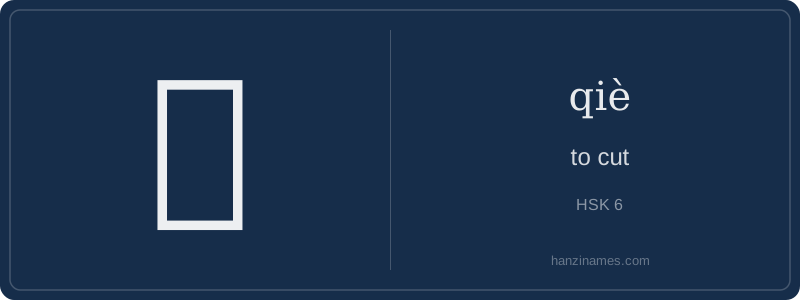
锲 is overwhelmingly used in the classical idiom 锲而不舍 (qiè ér bù shě), meaning 'to persevere without letting go'—a phrase derived from Xunzi’s 3rd-century BCE text, where it describes carving jade: even the hardest material yields to relentless, precise cutting. This idiom remains ubiquitous in education, motivational speeches, and official media (e.g., CCTV documentaries on scientific breakthroughs). It’s also found in technical terms like 车锲 (chē qiè, 'thread cutting') in mechanical engineering manuals.
The character’s form has no oracle-bone or bronze script attestation. It first appears reliably in Han-dynasty clerical script as a phono-semantic compound: 钅 (metal, semantic) + 契 (qiè, phonetic and semantic reinforcement—‘notched agreement’ implies exact, repeated action). Today, Chinese learners encounter it almost exclusively through 锲而不舍 — memorized in middle school and tested in HSK 6 reading sections.
Our detective begins at the crime scene: the character 锲 (qiè). At first glance, it’s a metal radical 钅 paired with 契 — a clue pointing to precision and force. Historically, ‘cutting’ wasn’t just physical; in ancient bronze inscriptions and clerical script, characters with 钅 often denoted tools or actions involving sharp implements—like chiseling inscriptions into stone or ritual bronze vessels. This wasn’t casual slicing—it was deliberate, incisive, permanent marking.
Zooming in on 契, we find its own layered history: originally a pictograph of a notched tally stick used in contracts (as confirmed in Shuowen Jiezi, 100 CE), symbolizing agreement through physical division. When fused with 钅, 锲 amplifies that idea—cutting *with intent*, *with instrument*, *with consequence*. It’s no accident that this character appears almost exclusively in literary, idiomatic, or technical contexts—not in everyday verbs like ‘cut paper’ (which uses 切 or 剪).
The evolution isn’t linear but semantic: from tangible tool-based cutting → to metaphorical perseverance (as in 锲而不舍) → to modern technical usage like ‘cutting threads’ (车锲) in machining. Its rarity in spoken Mandarin (it’s virtually never used alone) underscores its lexical weight—it’s a ‘character with a warrant,’ reserved for high-register expressions where precision and persistence intersect. No slang, no shortcuts—just 14 strokes of disciplined meaning.
Example Sentences
Common Compounds
Similar Characters — Don't Mix These Up
Your First Step into Chinese Culture: Get a Chinese Name
Every journey into Chinese begins with a name. Use our free Chinese name generator to create a meaningful, personalized Chinese name that fits you perfectly.
Get My Chinese Name →