铸
Character Story & Explanation
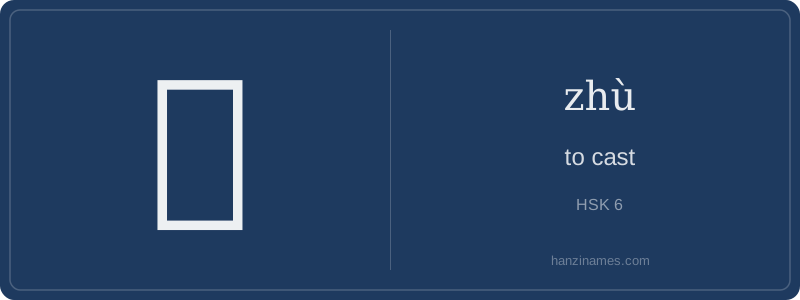
In modern China, 铸 appears frequently in formal and technical contexts: state media reports on ‘铸牢中华民族共同体意识’ (zhù láo Zhōnghuá Mínzú Gòngtóng Tǐ Yìshí)—a key political phrase meaning 'forge a firm sense of community for the Chinese nation.' It’s also central in metallurgy education, engineering certifications, and historical documentaries about ancient bronzes. Idiomatically, 铸成大错 (zhù chéng dà cuò) — 'to cast a grave mistake' — is widely used in news and literature to denote irreversible, systemic errors.
The character’s form reflects its function: the left radical 钅 (jīn) is the standardized ‘metal’ component, adopted in the 1956 script reform to replace the older 金 radical in simplified characters. The right side 主 (zhǔ), meaning 'master' or 'host,' signals agency—the human hand directing the process. No oracle-bone or bronze-inscription origin is documented for this specific shape; it emerged in clerical script during the Han dynasty as a phonosemantic compound, with 主 providing sound (archaic *tjuʔ) and meaning resonance.
Imagine standing in a sun-dappled courtyard at the Beijing Capital Iron and Steel Factory’s heritage museum—now repurposed as an industrial art park. A bronze plaque gleams under soft light, inscribed with the character 铸. Its sharp, metallic radical 钅 (‘metal’) anchors the character, while the right side 主 (zhǔ) hints at centrality and control—evoking the precision required when molten metal is poured into molds. This isn’t just a glyph; it’s a fossilized moment of human mastery over fire and matter.
Historically, 铸 shaped China’s technological and political power. From Zhou dynasty ritual bronzes bearing ancestral inscriptions to Ming-era cannon foundries, casting metal meant projecting authority. Even today, the character appears on state-owned enterprise logos and national infrastructure project plaques—not as archaic jargon, but as a living symbol of foundational strength and deliberate creation.
Unlike abstract verbs, 铸 carries weight, heat, and consequence. You don’t ‘cast’ lightly: it implies permanence, investment, and irrevocability—whether forging a bronze bell, a national policy, or even one’s character (as in 铸造品格). Its twelve strokes mirror the disciplined sequence of foundry work: prepare mold → melt alloy → pour → cool → finish. Every stroke is a step in transformation from raw potential to enduring form.
Example Sentences
Common Compounds
Similar Characters — Don't Mix These Up
Your First Step into Chinese Culture: Get a Chinese Name
Every journey into Chinese begins with a name. Use our free Chinese name generator to create a meaningful, personalized Chinese name that fits you perfectly.
Get My Chinese Name →