鉴
Character Story & Explanation
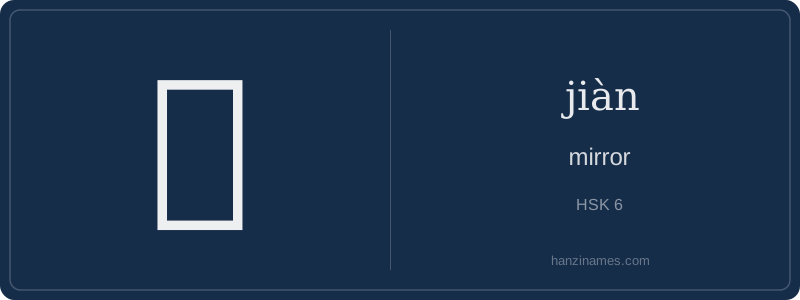
In daily life, 鉴 appears most often in formal compound words—not as a standalone noun. It’s central to the idiom ‘前车之鉴’ (qián chē zhī jiàn), meaning 'a warning from past mistakes' (literally 'the precedent cart’s mirror'), cited in historical texts like the *Zuo Zhuan* to urge rulers to learn from prior failures. Modern usage includes official documents, art criticism, and education policy—e.g., ‘经验借鉴’ (experiential reference).
Historically, 鉴 was a pictophonetic character: the left 金 radical indicates material (bronze), while the right 监 (jiān) provides both sound and semantic cue—'supervising' implies attentive observation, mirroring how a bronze mirror enables self-reflection. No oracle-bone form survives, but bronze mirrors inscribed with auspicious motifs have been excavated from Warring States tombs (475–221 BCE), confirming its early material basis.
Hi students! Let’s explore 鉴 (jiàn), a character with deep cultural roots. Though its basic meaning is 'bronze mirror'—a polished metal reflective surface used in ancient China—it evolved to mean 'to examine', 'to reflect upon', or 'to learn from experience'. This shift makes sense: just as a mirror shows your true appearance, 鉴 asks you to look honestly at facts, history, or behavior. It’s not about quick judgment—it’s thoughtful, critical observation.
The radical 金 (jīn, 'metal') tells us this character originally related to metal objects—and indeed, early mirrors were cast bronze discs. The right side, 监 (jiān), means 'to supervise' or 'to watch closely', reinforcing the idea of careful scrutiny. Together, they form a powerful concept: using metal tools (like mirrors) to enable clear insight—both literally and metaphorically.
At HSK Level 6, 鉴 appears in formal, literary, or academic contexts—not everyday small talk, but essential for understanding serious writing. You’ll see it in phrases like ‘借鉴’ (jièjiàn, 'to draw lessons from') or ‘鉴赏’ (jiànshǎng, 'to appreciate and critically assess'). Think of it as the Chinese equivalent of 'critical reflection'—a skill that bridges ancient ritual and modern analysis.
Example Sentences
Common Compounds
Similar Characters — Don't Mix These Up
Your First Step into Chinese Culture: Get a Chinese Name
Every journey into Chinese begins with a name. Use our free Chinese name generator to create a meaningful, personalized Chinese name that fits you perfectly.
Get My Chinese Name →