阂
Character Story & Explanation
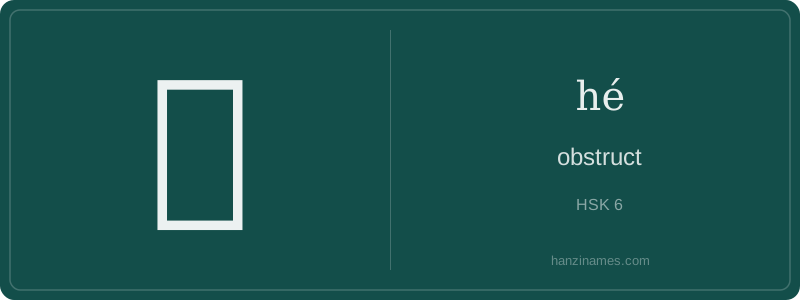
阔回 is rare in spoken Mandarin but persists in formal writing, especially in classical allusions and bureaucratic or academic contexts. It appears in the idiom 隔阂 (gé hé), meaning 'estrangement' or 'barrier between people' — a term widely used in sociology, diplomacy, and cross-cultural education since the 1980s. The State Council’s 2021 white paper on ethnic unity cites 消除隔阂 ('eliminate barriers') as a policy goal. It also occurs in historical texts like the *Book of Han*, describing geographical or political impediments.
The character is not pictographic — no archaeological evidence shows an oracle-bone or bronze form. Instead, its structure is clearly semantic-phonetic: 门 (gate) signals domain of obstruction; 曷 provides pronunciation. Today, Chinese learners encounter it almost exclusively through 隔阂, often in textbooks discussing interpersonal or cultural misunderstandings.
Our detective work begins at the scene: the character 阂. At first glance, it’s a gate (门) with a ‘harmony’ or ‘together’ component (曷) inside — but don’t be misled by the phonetic hint. The radical 门 (gate) is no mere decoration: in ancient Chinese semantics, gates symbolize thresholds, boundaries, and points of access — or blockage. This visual metaphor anchors the core meaning: something that stands *in the doorway*, halting passage.
Zooming in on the phonetic component 曷 (hé), we find it originally meant ‘what?’ or ‘why?’ in classical texts — but here, it serves primarily as a sound cue. Crucially, 阂 never evolved from a pictograph of obstruction; rather, it was deliberately constructed in the Warring States to Han periods as a semantic-phonetic compound (形声字), assigning the gate radical to convey spatial or social barrier, while borrowing 曷’s pronunciation.
This character didn’t emerge from oracle bones or bronze inscriptions — it appears first reliably in excavated bamboo slips from the late Warring States (e.g., *Shangshu* fragments) and early Han texts. Its rarity in daily speech today reflects its literary register: 阂 survives not in chatter, but in measured prose — where precision matters, and ‘obstruction’ must carry weight, nuance, and classical resonance.
Example Sentences
Common Compounds
Similar Characters — Don't Mix These Up
Your First Step into Chinese Culture: Get a Chinese Name
Every journey into Chinese begins with a name. Use our free Chinese name generator to create a meaningful, personalized Chinese name that fits you perfectly.
Get My Chinese Name →