阱
Character Story & Explanation
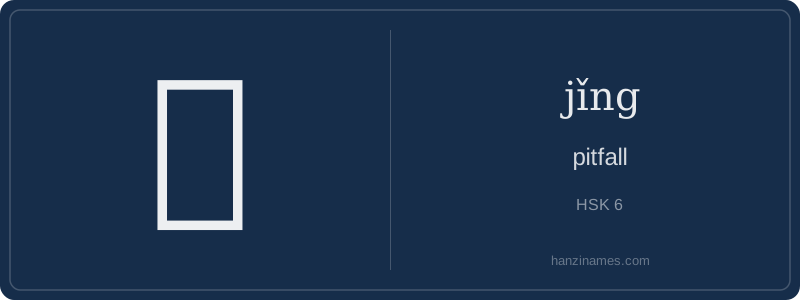
In modern usage, 阱 appears primarily in literary, political, and business contexts to denote metaphorical traps—such as ideological blind spots, regulatory loopholes, or cognitive biases. It features prominently in the idiom míng zhēng àn jǐng (明争暗阱), meaning 'open conflict and hidden pitfalls', used in journalism and policy analysis to critique systemic risks masked by visible debates. Historically, it appears in the *Zuo Zhuan* (c. 4th century BCE) describing literal hunting pits—and later in Tang dynasty poetry as a symbol of treacherous court politics.
The character’s form is not pictographic but phono-semantic: the left component 井 (jǐng, 'well') suggests both sound and concept (a deep, vertical excavation), while the right-side 阝 (originally 阜, fù, 'mound/hill') indicates terrain-related location. This structure reflects its earliest documented use: a pit dug on sloped land to capture animals—verified in excavated Warring States bamboo texts and Han dynasty legal statutes regulating hunting grounds.
At first glance, 阱 (jǐng) appears as a simple character for 'pitfall'—a concealed trap dug in the ground. Yet in classical Chinese thought, it embodies a profound cultural awareness of hidden danger and moral vulnerability. Unlike overt threats, a 阱 is invisible until stepped into, mirroring how deception, complacency, or flawed judgment can silently undermine integrity or success. This reflects a worldview deeply attentive to subtext, consequence, and the quiet perils lurking beneath surface calm.
The character’s right-side radical 阝 (the 'hillside' or 'city wall' variant) signals location and boundary—suggesting danger is not abstract but spatially anchored, often man-made and socially embedded. In Daoist and Confucian texts, 阱 metaphorically extends to ethical snares: ambition without virtue, speech without sincerity, or power without restraint. Thus, it functions less as a physical object and more as a philosophical caution against self-deception and systemic risk.
This nuanced conception reveals a core Chinese epistemological stance: truth and safety are not found in ignoring complexity, but in cultivating vigilance, humility, and contextual awareness. To recognize a 阱 is to practice *shèn* (caution), a virtue extolled in the *Analects* and *Xunzi*. The character thus serves as a linguistic distillation of a civilizational ethic—one that values foresight over force, prevention over rescue, and wisdom that sees what lies just beneath the surface.
Example Sentences
Common Compounds
Similar Characters — Don't Mix These Up
Your First Step into Chinese Culture: Get a Chinese Name
Every journey into Chinese begins with a name. Use our free Chinese name generator to create a meaningful, personalized Chinese name that fits you perfectly.
Get My Chinese Name →