陈
Character Story & Explanation
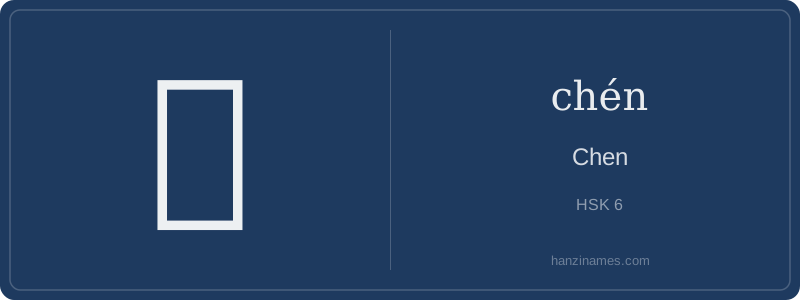
陈 is overwhelmingly used today as a surname—over 60 million people in China bear it, including former President Chen Shui-bian and Nobel laureate Chen Ning Yang. It appears in historical terms like '陈国' (Chén Guó, the Zhou state) and idioms such as '新陈代谢' (xīn chén dài xiè, 'metabolism'), where 'chén' denotes 'old matter'. The State Council’s 2020 surname statistics confirm its top-five national rank.
The character’s written form derives from seal script: the right side is 东 (dōng, 'east'), indicating the state’s location east of Zhou; the left is 阝 (fù, 'mound/earth'), a variant of 阜, signifying terrain. No oracle bone form survives, but Western Zhou bronze inscriptions (e.g., the 'Chen Bo Gui') verify this structure—no chariots or displays involved.
As a detective tracing 陈’s evolution, I begin at the Zhou dynasty (1046–256 BCE): 陈 was a real vassal state in present-day Henan—its name inscribed on bronze ritual vessels like the 'Chen Hou Gui' (c. 5th century BCE), where the character appears in early seal script with a clear 'earth' (阝, right ear radical) and 'east' (东) component, denoting its geographical location east of the Zhou heartland.
By the Qin and Han dynasties, 陈 transformed from a toponym into a surname—China’s fifth most common family name today. The character stabilized in clerical script around 200 BCE: the left side simplified from ‘阜’ (mound/earth) to the modern 阝 radical, while the right retained 东 (dōng, 'east'), preserving its original directional-geographic logic—not a pictograph of a chariot or display, as some folk etymologies claim.
Modern standardization cemented 陈 as a 7-stroke character in 1956’s *List of Commonly Used Characters*. Its HSK Level 6 status reflects its frequency in historical texts and formal usage—not everyday speech—but it appears reliably in names, academic history, and idioms like '推陈出新' (tuī chén chū xīn, 'discard the old, bring forth the new'), where 'chén' means 'old, outdated', semantically extended from 'ancient state' to 'obsolete'. This semantic drift is well-documented in the *Shuōwén Jiězì* (121 CE).
Example Sentences
Common Compounds
Similar Characters — Don't Mix These Up
Your First Step into Chinese Culture: Get a Chinese Name
Every journey into Chinese begins with a name. Use our free Chinese name generator to create a meaningful, personalized Chinese name that fits you perfectly.
Get My Chinese Name →