陵
Character Story & Explanation
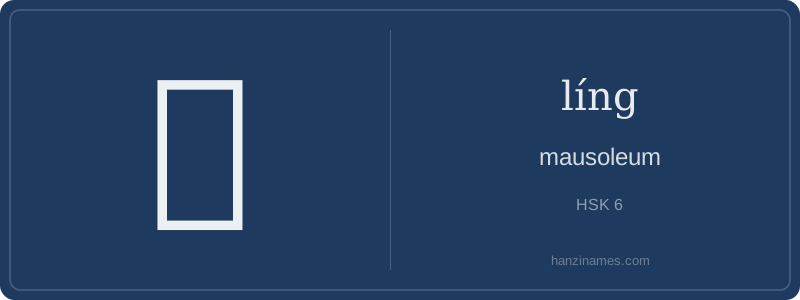
陵 appears most frequently in historical and cultural contexts: in names of imperial tombs (e.g., Ming Tombs = 明十三陵 Míng Shísān Líng), academic discussions of ancient burial practices, and official heritage site signage. It features in the idiom 陵谷变迁 (líng gǔ biàn qiān), meaning 'profound societal change'—literally 'mounds becoming valleys, valleys becoming mounds', echoing the Book of Songs’ lament on impermanence. It also appears in place names like 钟陵 Zhōnglíng (a historic district in Jiangxi).
The character’s written form has a clear documented origin: 阝 (right) is the standardized form of 阜 fù, meaning 'mound' or 'elevated land', used as a semantic radical since bronze script; 令 provides the pronunciation. There is no disputed oracle-bone origin—archaeological consensus confirms its emergence in mid-to-late Zhou bronze inscriptions exclusively for royal burial sites.
Our detective begins at the crime scene: the character 陵 (líng). Early seal script shows a hill-shaped element (阝, the 'mound' radical on the right) paired with 令—originally a pictograph of a commanding officer issuing orders from an elevated platform. This fusion suggests authority over terrain—fitting for imperial burial mounds where power met earth. The radical 阝 (right ear旁) here is not 'ear' but the 'mound/hill' variant, distinct from the left-side 阝 ('city') radical.
Zooming in on the evidence: 令’s role evolved phonetically. Though it once conveyed 'command', by the Warring States period it served primarily as a sound clue for líng, while the semantic weight shifted fully to the mound radical. No oracle bone inscriptions contain 陵—its earliest confirmed appearance is in bronze inscriptions of the late Zhou, always tied to elite tombs. This isn’t a word for any hill—it’s reserved for monumental, human-made elevations with ritual gravity.
The character’s ten strokes conceal a quiet hierarchy: first the mound (阝) is sketched, then the phonetic 令 is added—reinforcing that form follows function. Its HSK 6 status reflects its specialized, literary register: rarely heard in casual speech, yet indispensable in historical texts, archaeology reports, and classical poetry. Detectives note that modern usage almost never means ‘small mound’; contextually, it implies scale, antiquity, and reverence—like finding a royal signature stamped onto geography itself.
Example Sentences
Common Compounds
Similar Characters — Don't Mix These Up
Your First Step into Chinese Culture: Get a Chinese Name
Every journey into Chinese begins with a name. Use our free Chinese name generator to create a meaningful, personalized Chinese name that fits you perfectly.
Get My Chinese Name →