陶
Character Story & Explanation
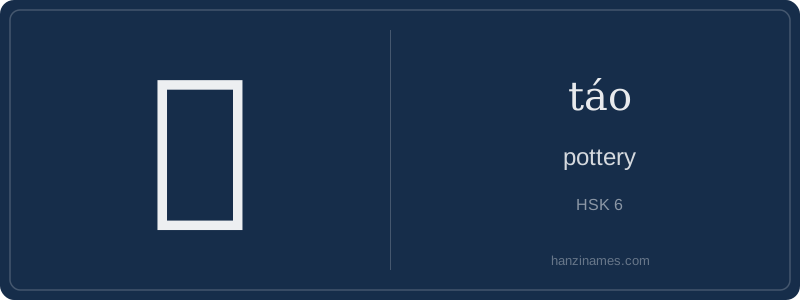
In modern Chinese, 陶 appears most frequently in compound words related to ceramics (e.g., 陶瓷 cí táo 'ceramics') and figurative cultivation (e.g., 陶冶 'to refine morally'). It’s central to historical terms like 唐三彩 (Táng Sāncǎi), the famed glazed earthenware of the Tang Dynasty, excavated from tombs across Xi’an. The character also appears in surnames (e.g., 陶渊明 Táo Yuānmíng, the Eastern Jin poet and 'Peach Blossom Spring' author), reinforcing its cultural weight.
The character’s form evolved from seal script, where 阝 (originally 邑 yì, 'city') on the left denoted administrative or regional association—pottery production was often state-regulated. The right side 匋 is a phonosemantic compound itself, with 尸 (shī, 'body') + 皿 (mǐn, 'vessel') + 彡 (shān, 'ornament'), reflecting decorated, functional ware. No oracle bone form survives; earliest attestation is in Warring States bamboo slips.
As an archaeologist brushing dust from a Han dynasty kiln shard, I see 陶 not just as 'pottery'—but as a fossilized verb. Its left side, 阝 (the 'mound' or 'city wall' radical), anchors it in place: pottery was born in settled communities, near clay-rich riverbanks and communal kilns. This radical signals geography, governance, and craft infrastructure—not mere decoration.
The right side, 匋 (táo, archaic form of 陶), is phonetic but also semantic: it originally depicted a vessel being shaped on a wheel, with the top element (勹) suggesting enclosure or wrapping, and the bottom (缶 fǒu) meaning 'earthenware jar'. So 陶 is a rare compound where sound and meaning converge like glaze on clay—both telling the story of human transformation of earth.
Crucially, 陶 carries a profound philosophical resonance beyond ceramics. In Daoist and Confucian texts, 陶 means 'to mold', 'to cultivate', or 'to refine'—as in 陶冶 (táo yě), 'to temper one’s character through experience'. Just as clay becomes vessel under fire, the self becomes virtuous through practice. This dual life—material artifact and moral metaphor—makes 陶 one of Chinese writing’s most deeply fired characters.
Example Sentences
Common Compounds
Similar Characters — Don't Mix These Up
Your First Step into Chinese Culture: Get a Chinese Name
Every journey into Chinese begins with a name. Use our free Chinese name generator to create a meaningful, personalized Chinese name that fits you perfectly.
Get My Chinese Name →