隙
Character Story & Explanation
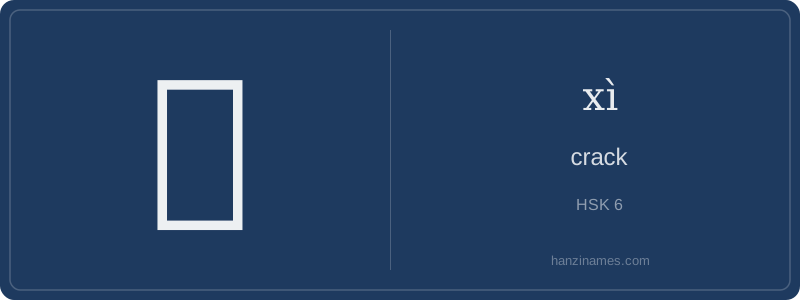
Historically, 隙 appears in early classical texts like the *Zuo Zhuan* (4th c. BCE) describing structural gaps in fortifications and diplomatic misalignments. Today, it's most commonly used in compound words like 间隙 (jiàn xì, 'interval') and 缝隙 (fèng xì, 'crack or crevice'). The idiom 可乘之隙 ('an exploitable opening') remains widely taught in HSK 6 curricula and appears in modern political commentary and business strategy discussions.
The character evolved from seal script, where the right side () represented 'to separate' or 'to part', and the left-side radical 阝 (阜) signifies 'mound' or 'terrain'—together evoking a natural fissure in a hillside. Its modern form retains this topographic origin, reflecting how ancient Chinese observed landscape features as metaphors for social and psychological phenomena.
At first glance, 隙 (xì) means 'crack'—a narrow opening between things. But in the Chinese worldview, such gaps are never merely physical flaws; they embody dynamic tension between unity and separation, presence and absence. Like the Taoist interplay of yin and yang, a 隙 is where change begins: light enters darkness, air flows, opportunity emerges. This reflects a deep cultural sensitivity to thresholds—not as failures of wholeness, but as vital, generative spaces.
The character invites reflection on impermanence and relationality. In classical texts, 隙 appears not just in descriptions of broken walls or fractured ice, but metaphorically in human relationships—'a crack in trust' (信任的缝隙) or 'a gap in understanding'—suggesting that awareness of fissures precedes healing. Unlike Western binaries that often frame cracks as defects to be sealed, Chinese thought treats them as diagnostic signs and openings for renewal.
This philosophical nuance extends into governance and strategy: Sun Tzu’s *Art of War* stresses exploiting the enemy’s ‘gaps’ (可乘之隙)—not just tactical weaknesses, but temporal, perceptual, or moral fissures. Thus, 隙 reveals a worldview where precision lies not in eliminating difference, but in perceiving and navigating the subtle intervals that structure reality—between words and meaning, action and intention, self and other.
Example Sentences
Common Compounds
Similar Characters — Don't Mix These Up
Your First Step into Chinese Culture: Get a Chinese Name
Every journey into Chinese begins with a name. Use our free Chinese name generator to create a meaningful, personalized Chinese name that fits you perfectly.
Get My Chinese Name →