障
Character Story & Explanation
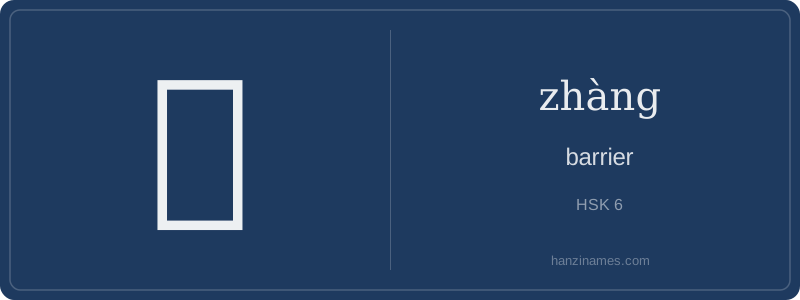
障 is widely used in contemporary Chinese to describe both physical and abstract barriers — especially in official, medical, and educational contexts. It appears in standardized terms like 残疾人无障碍设施 (cánjí rén wú zhàng’ài shèshī, barrier-free facilities for persons with disabilities), a phrase mandated nationwide since China’s 2008 Regulations on Barrier-Free Environment. The idiom 一叶障目 (yī yè zhàng mù, 'a single leaf blocks the view') dates back to the Warring States period (4th c. BCE) and remains common in writing and speeches to warn against narrow-mindedness.
The character evolved from seal script, where 阜 (fù, hill/mound) on the left represented terrain features that could impede movement, and 章 (zhāng) on the right served as a phonetic component. While not a pictograph, its form consistently reflected the idea of obstruction tied to landscape or regulation — a documented semantic-phonetic compound (形声字) in standard historical lexicography.
Hi students! Let’s look at the character 障 (zhàng). It means 'to block' or 'obstacle' — something that stands in the way, like a wall, barrier, or hindrance. Though it looks complex with 13 strokes, its structure is logical: the left side 阝 (the 'hill' or 'mound' radical, originally 阜) suggests terrain or elevation, and the right side 章 (zhāng) gives sound and hints at 'pattern' or 'regulation' — together implying a man-made or natural obstruction that disrupts flow.
This character is not used alone in modern speech; it almost always appears in compound words. You’ll see it in formal, academic, or technical contexts — especially when discussing social, psychological, or physical barriers. Think of it as the 'block' in 'roadblock' or 'blockage', not the casual 'stop' (停) or 'prevent' (阻止), but something more structural and persistent.
As an HSK Level 6 character, 障 reflects advanced vocabulary — it’s essential for reading news, policy documents, or literature about societal challenges. Don’t try to memorize it by rote! Instead, connect it to real phrases you’ll encounter: 视障 (shìzhàng, visual impairment), 心理障碍 (xīnlǐ zhàng’ài, psychological barrier), or 障碍物 (zhàng’ài wù, obstacle). Once you know these, 障 becomes instantly recognizable and meaningful.
Example Sentences
Common Compounds
Similar Characters — Don't Mix These Up
Your First Step into Chinese Culture: Get a Chinese Name
Every journey into Chinese begins with a name. Use our free Chinese name generator to create a meaningful, personalized Chinese name that fits you perfectly.
Get My Chinese Name →