隧
Character Story & Explanation
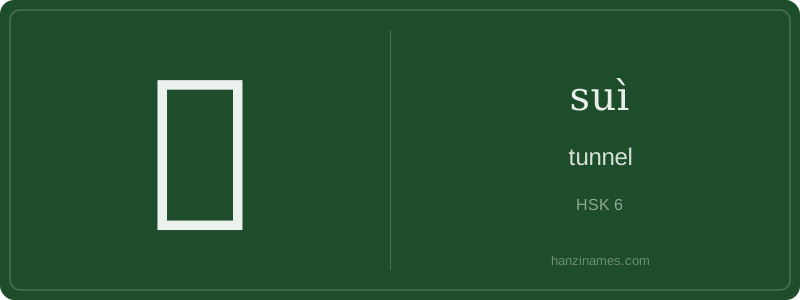
In modern China, 隧 is indispensable in transportation infrastructure: the Beijing–Shanghai high-speed rail uses over 200 tunnels; the Hong Kong–Zhuhai–Macau Bridge includes a 6.7-km undersea tunnel — officially named 港珠澳大桥海底隧道 (Gǎngzhū’ào Dàqiáo Hǎidǐ Suìdào). It appears in official documents, safety signage (e.g., 隧道限速 ‘tunnel speed limit’), and news reports on engineering milestones. The term 隧道 (suìdào) is standard in all technical and public contexts.
The character has no verified pictographic origin — it’s a phono-semantic compound, not a drawing of a tunnel. Instead, picture this: a Beijing subway rider glancing at a station sign reading 西二旗隧道出口 (Xī’èrqí Suìdào Chūkǒu — 'West Erqi Tunnel Exit') — that’s how most Chinese encounter 隧 daily: functional, unobtrusive, and utterly essential.
Our detective begins at the crime scene: the character 隧 (suì), meaning 'tunnel'. First, observe its structure — a left–right compound with 阝 (the 'mound' or 'hill' radical, historically derived from 邑 yì, meaning 'city' or 'settlement') on the right, and 遂 (suì) on the left. This isn’t coincidence: 遂 itself means 'to accomplish' or 'to succeed', but here it serves phonetically — providing the sound suì while hinting at purposeful, deliberate passage through terrain.
Zoom in on the radical: 阝 as the right-side variant of 邑 signals a connection to human habitation, infrastructure, or territorial boundaries — fitting for tunnels built *between* places, often linking cities or crossing mountains. Early Chinese engineering feats, like Han Dynasty mountain passes and Ming-era canal underpasses, required such engineered conduits — making 隧 both technical and geopolitical.
Unlike pictographic characters, 隧 emerged later — no oracle bone or bronze inscriptions contain it. Its first reliable appearances are in Warring States bamboo texts and the Han dynasty’s Shuōwén Jiězì, where it’s defined as 'a passageway dug through earth or rock'. The 14-stroke composition reflects increasing specialization: as China expanded infrastructure, language evolved precise terms for subterranean passages — distinguishing 隧 from generic holes (穴 xué) or gates (門 mén).
Example Sentences
Common Compounds
Similar Characters — Don't Mix These Up
Your First Step into Chinese Culture: Get a Chinese Name
Every journey into Chinese begins with a name. Use our free Chinese name generator to create a meaningful, personalized Chinese name that fits you perfectly.
Get My Chinese Name →