雀
Character Story & Explanation
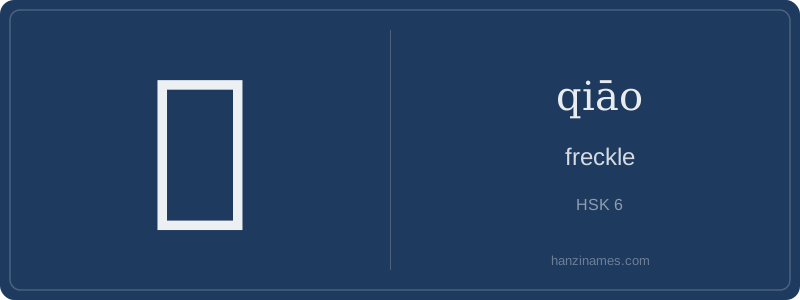
In daily life, 雀 appears almost exclusively in the compound 雀斑 (quèbān), meaning 'freckle'—a term used medically, cosmetically, and conversationally across China. It’s common in dermatology clinics, skincare ads, and social media discussions about 'natural beauty'. Historically, the word appears in Ming-Qing medical texts like Bencao Gangmu (Compendium of Materia Medica), where 'quèbān' is described as benign pigmentation linked to sun exposure and constitutional factors—not disease, but a bodily pattern.
Graphically, 雀 is a phono-semantic compound: the radical 隹 (zhuī) means 'short-tailed bird' and signals the avian origin; the phonetic component 厶+小 (simplified form of 省 shěng, now read què/qiāo) hints at pronunciation. Oracle bone or bronze inscriptions don’t attest to 雀; its earliest secure forms appear in Warring States bamboo slips, consistently depicting a sparrow-like bird.
The character 雀 (qiāo/què) opens a window into the Chinese worldview where nature, body, and language intertwine with poetic precision. Though its primary meaning today is 'freckle'—a tiny, scattered mark on skin—it originally denoted 'sparrow', a small, lively bird deeply embedded in agrarian life and classical poetry. This semantic shift reveals how Chinese perception often maps natural phenomena onto the human body: just as sparrows flit unpredictably across skies, freckles appear spontaneously across cheeks—both seen as natural, unforced, and quietly abundant.
Chinese aesthetics traditionally value subtlety and organic variation over uniformity; freckles are not flaws but '雀斑' (quèbān)—literally 'sparrow spots'—evoking charm, youth, and authenticity. In contrast to Western cosmetic erasure, classical texts and modern colloquial usage often treat them with gentle fondness, even affection. The character thus carries cultural warmth: a reminder that imperfection, when observed with care, becomes a signature of individuality and vitality.
This duality—bird and blemish—mirrors broader Chinese philosophical patterns: yin-yang interplay, transformation (bianhua), and the reverence for small, humble things. Sparrows nest near homes, sing at dawn, survive winters—emblems of resilience and everyday grace. Freckles, too, endure sun and time, marking lived experience without pretense. To learn 雀 is to glimpse how Chinese language encodes reverence for the modest, the transient, and the intimately personal—not as defects, but as quiet poetry written on skin and sky alike.
Example Sentences
Common Compounds
Similar Characters — Don't Mix These Up
Your First Step into Chinese Culture: Get a Chinese Name
Every journey into Chinese begins with a name. Use our free Chinese name generator to create a meaningful, personalized Chinese name that fits you perfectly.
Get My Chinese Name →