雅
Character Story & Explanation
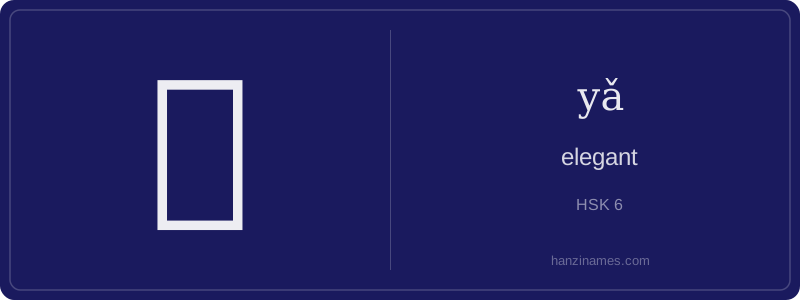
In modern Chinese, 雅 is rarely used alone—it thrives in compounds denoting refinement: 高雅 (gāoyǎ, 'high elegance'), 文雅 (wényǎ, 'cultured grace'), and the HSK-6 idiom 雅俗共赏 (yǎsú gòngshǎng, 'appreciated by both refined and popular audiences'), famously applied to works like *The Story of the Stone*. Historically, it anchored the *Yǎ* section of the *Shījīng* (Classic of Poetry), comprising 105 court hymns distinguished by formal diction and ritual function.
The character’s seal-script form (c. 3rd c. BCE) combines 隹 (a phonetic component, not semantic bird) and 牙 (yá, 'fang' or 'tooth', here serving as phonetic loan). No oracle bone form survives, and scholarly consensus rejects folk etymologies linking it to birdsong. Today, Chinese speakers encounter it most often in cultural contexts—e.g., 雅集 (yǎjí, 'elegant gathering'), a term revived for contemporary literary salons.
As an archaeologist brushing dust from a Han dynasty bamboo slip, I find 雅 inscribed in elegant clerical script—not as mere decoration, but as a philosophical marker. Its presence in texts like the *Yǎjīng* (Elegance Canon), a lost companion to the *Shījīng*, signals early standardization of refined speech and ritual comportment among Zhou aristocrats. The character wasn’t just descriptive; it functioned as a cultural sieve—distinguishing courtly diction from regional vernaculars.
Excavations at Mawangdui revealed silk manuscripts where 雅 appears alongside phonetic glosses, confirming its role in linguistic orthodoxy. Scribes used it to annotate ‘correct’ pronunciations—akin to medieval Latin’s *sermo purus*. This wasn’t aesthetic preference alone: it encoded political legitimacy. To speak *yǎ* was to align with the central court’s authority, making the character a quiet instrument of imperial unification through language.
Even in Tang tomb inscriptions, 雅 persists—not in poetry titles alone, but in epitaphs praising officials for ‘雅量’ (elegant capacity), denoting moral composure under pressure. The radical 隹 (short-tailed bird) hints not at avian imagery, but likely phonetic borrowing: early forms show interchangeability with *yā*, reinforcing its function as a *sound-based classifier* for cultivated expression. Its elegance lies in precision, not ornament.
Example Sentences
Common Compounds
Similar Characters — Don't Mix These Up
Your First Step into Chinese Culture: Get a Chinese Name
Every journey into Chinese begins with a name. Use our free Chinese name generator to create a meaningful, personalized Chinese name that fits you perfectly.
Get My Chinese Name →