雇
Character Story & Explanation
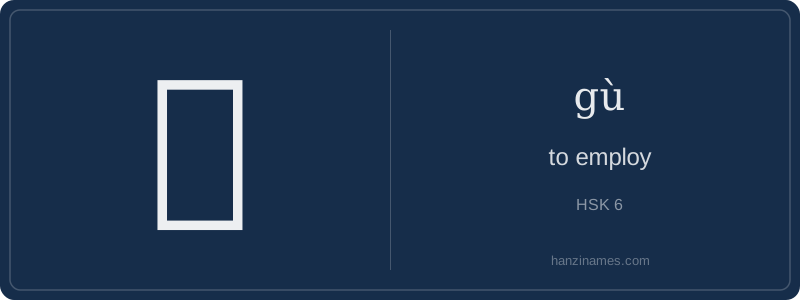
In contemporary China, 雇 appears routinely in official documents, job advertisements, and labor arbitration rulings. It’s central to phrases like ‘雇用关系’ (employment relationship) — a legally defined concept under the PRC Labor Contract Law (2008). Major employers like Foxconn or Alibaba explicitly use 雇 in internal HR policies, and courts cite it when determining whether platform workers qualify as employees. The term also appears in the phrase ‘雇主责任’ (employer liability), a key principle in civil litigation.
The character’s form has no pictographic origin; it’s a phono-semantic compound. The left side 隹 is the radical (indexing birds but functioning here as a phonetic component in related characters), while 故 provides both sound and semantic nuance (‘intentional action’). In daily life, Chinese people encounter 雇 most often on printed contracts, WeChat work-group announcements, or municipal labor bureau posters — always signaling formal, accountable engagement.
The character 雇 (gù) captures the formal, contractual act of hiring someone for labor or services — not casual help, but a deliberate, often documented employment relationship. Its radical 隹 (zhuī), meaning 'short-tailed bird', may seem unrelated at first, but historically appears in characters linked to movement, dispatch, or selection — fitting for assigning roles. The right side, 故 (gù), means 'reason' or 'former', suggesting purposeful, intentional action: one employs *for a reason*, with clear intent and expectation.
At HSK Level 6, 雇 signals advanced vocabulary mastery — it’s rarely used in spoken colloquial Mandarin (where 找人帮忙 or 聘 is more common), but essential in legal, HR, and business contexts. You’ll see it in labor contracts (劳动合同), government notices about migrant worker rights, and news reports on gig-economy regulation. Its tone (fourth tone) and crisp pronunciation mirror its decisive semantic weight: no ambiguity — someone is being formally engaged.
This character reflects China’s evolving labor landscape: from state-assigned work units in the planned economy era to today’s platform-based hiring (e.g., food delivery riders employed via Meituan or Ele.me). Though digital platforms use algorithms, the legal framework still relies on 雇 — as affirmed in China’s 2021 Guiding Opinions on Protecting Labor Rights of New-Form Employment Workers. Thus, 雇 bridges historical bureaucracy and modern economic reality.
Example Sentences
Common Compounds
Similar Characters — Don't Mix These Up
Your First Step into Chinese Culture: Get a Chinese Name
Every journey into Chinese begins with a name. Use our free Chinese name generator to create a meaningful, personalized Chinese name that fits you perfectly.
Get My Chinese Name →