雌
Character Story & Explanation
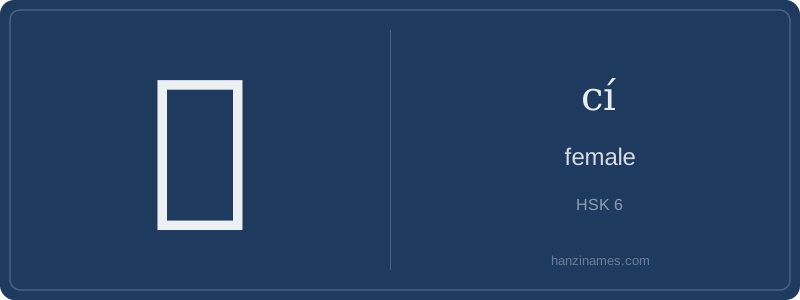
In modern Chinese, 雌 appears frequently in biology, ecology, and agriculture — e.g., government reports on endangered species always specify 雌性个体 (females) vs. 雄性个体 (males). It's also key in the idiom 雌雄同体 (cíxióng tóngtǐ, 'hermaphrodite'), used medically and scientifically. Classical usage dates back to at least the Warring States period, where texts like the *Zhuāngzǐ* contrasted 雌 (yin/female/passive) and 雄 (yang/male/active) as cosmic principles.
The character’s earliest documented form (small seal script, c. 3rd century BCE) combines 隹 (bird radical, indicating animal category) and 此 (cǐ, phonetic component, suggesting pronunciation). There’s no pictographic 'female figure' — it’s a phono-semantic compound, not a pictograph. Today, Chinese students encounter it first in middle-school biology class, labeling diagrams of insects or birds.
Hi students! Let’s learn 雌 (cí), a character meaning 'female' — especially when referring to animals or biological sex. Unlike the more general 女 (nǚ, 'woman'), 雌 is used in scientific, literary, or formal contexts — think biology textbooks or classical poetry. It’s not for people; you’d never call a woman ‘雌’ — that would be rude or dehumanizing! Instead, it’s paired with 雄 (xióng, 'male') to form balanced, natural pairs like 雌雄 (cíxióng, 'male and female').
This character appears often in compound words and idioms, always carrying a precise, objective tone. Its radical 隹 (zhuī) means 'short-tailed bird', hinting at its ancient connection to animal classification — many early Chinese terms for gender originated in zoology. Even today, in wildlife documentaries or veterinary reports, 雌 is the standard term for 'female' individuals of non-human species.
Don’t confuse it with colloquial or emotive words like 妈妈 (māma, 'mom') or 女性 (nǚxìng, 'woman'). 雌 is neutral, technical, and respectful *in its proper context*. Mastering it helps you read scientific articles, understand traditional texts like the *Shuōwén Jiězì* (a Han dynasty dictionary that defines 雌 as 'the yin aspect of creatures'), and speak more precisely about nature and biology in Chinese.
Example Sentences
Common Compounds
Similar Characters — Don't Mix These Up
Your First Step into Chinese Culture: Get a Chinese Name
Every journey into Chinese begins with a name. Use our free Chinese name generator to create a meaningful, personalized Chinese name that fits you perfectly.
Get My Chinese Name →