雕
Character Story & Explanation
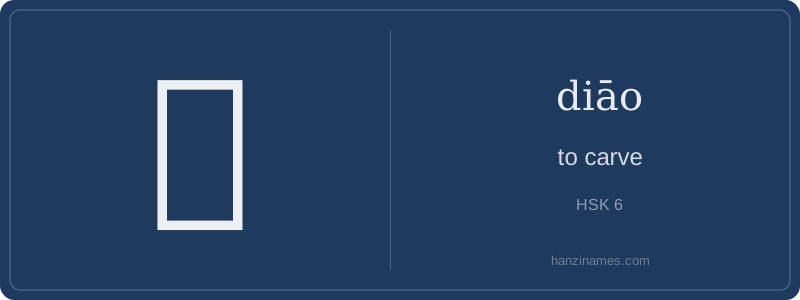
雕 is commonly used in phrases like 雕刻 (diāokè, 'carving/engraving'), appearing in museum labels, art school curricula, and UNESCO heritage documentation for sites like the Longmen Grottoes. A well-known idiom is 精雕细琢 (jīng diāo xì zhuó), meaning 'exquisitely carved and finely polished', used to describe painstaking attention to detail in writing, design, or education. Historically, Song dynasty texts record imperial workshops employing specialized 雕匠 ('carving masters') for lacquerware and ivory.
The character’s form derives from the radical 隹 (zhuī, 'short-tailed bird'), originally indicating the eagle/falcon sense—but the 'carve' meaning arose via phonetic loan (jiǎjiè). Its current shape (16 strokes) stabilized during the Han dynasty clerical script era. Today, Chinese students practice it in calligraphy classes emphasizing stroke order precision—especially the final three dots and the 'bird' component's balanced proportions.
The Chinese character 雕 (diāo) primarily means 'to carve' or 'to engrave'—a precise, deliberate act of shaping material like wood, stone, jade, or even ice. Unlike English verbs such as 'carve', which can imply rough cutting (e.g., carving a turkey), 雕 connotes artistry, refinement, and technical mastery. It appears in contexts ranging from traditional craftsmanship to metaphorical usage, such as 'carving out a career' (雕琢人生). Its association with fine detail reflects Confucian ideals of self-cultivation through disciplined effort.
Historically, 雕 is deeply tied to Chinese visual culture: imperial seals were carved (雕刻) by master artisans; Buddhist cave temples like Yungang feature thousands of intricately carved stone figures. The character also denotes the raptor 'eagle' or 'falcon'—a homophone (diāo) sharing the same written form but different etymology—illustrating how phonetic borrowing shaped Chinese orthography. This duality reminds learners that context is essential for accurate interpretation.
In modern usage, 雕 retains its core meaning of meticulous creation but extends into digital domains: '3D carving software' may be called 3D雕刻软件. It contrasts with broader verbs like 刻 (kè, 'to inscribe')—which emphasizes permanence—and 削 (xiāo, 'to pare/shave')—which implies removal rather than additive artistry. Western equivalents include 'chisel', 'engrave', or 'sculpt', yet none fully capture 雕’s cultural weight: it evokes centuries of literati admiration for craftsmanship as moral practice—not mere technique, but virtue made visible.
Example Sentences
Common Compounds
Similar Characters — Don't Mix These Up
Your First Step into Chinese Culture: Get a Chinese Name
Every journey into Chinese begins with a name. Use our free Chinese name generator to create a meaningful, personalized Chinese name that fits you perfectly.
Get My Chinese Name →