韧
Character Story & Explanation
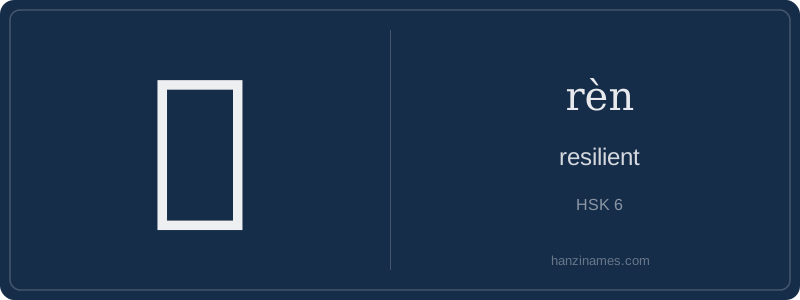
韧 is widely used in modern Chinese public discourse, especially since the 2010s, to describe national, economic, and psychological resilience. It appears in official documents like the 14th Five-Year Plan (2021–2025), which emphasizes '增强产业链韧性' ('enhancing the resilience of industrial supply chains'). The idiom '柔韧有余' (róu rèn yǒu yú)—meaning 'gracefully resilient, with room to spare'—is common in business and education contexts. Psychologists also use '心理韧性' (xīnlǐ rènxìng) as the standard term for 'psychological resilience' in clinical and academic literature.
The character 韧 first appeared in seal script during the Warring States period (475–221 BCE), derived from 韦 (tanned leather) + 刃 (blade/edge), symbolizing leather hardened yet flexible enough to hold an edge. Historical inscriptions confirm its early use in describing treated hides and later metaphorical endurance—no oracle-bone origins; it's a later, logical compound.
Hi students! Let’s explore 韧 (rèn), a subtle but powerful character. Though often translated as 'annealed'—a metallurgical term meaning toughened by heat and slow cooling—it’s used far more broadly in Chinese to describe resilience, flexibility under pressure, and quiet endurance. Unlike rigid strength (刚), 韧 suggests supple toughness: think of bamboo bending in the wind without breaking. It’s a highly valued quality in Chinese philosophy, especially in Daoist and martial arts thinking.
This character appears frequently in abstract, positive contexts—not in everyday casual speech, but in writing, speeches, and formal descriptions of people, policies, or materials. You’ll encounter it in phrases like '韧性发展' (resilient development) or when praising someone’s '心理韧性' (psychological resilience). Its tone is respectful and admiring, never neutral.
Don’t confuse 韧 with simple 'strength' or 'hardness'. Its radical 韦 (wéi) originally meant 'tanned leather'—a material that’s both pliable and durable. That ancient association still echoes today: true resilience isn’t about resisting force, but absorbing, adapting, and recovering. As you learn HSK 6 vocabulary, mastering 韧 helps express nuanced, mature ideas about human and systemic endurance.
Example Sentences
Common Compounds
Similar Characters — Don't Mix These Up
Your First Step into Chinese Culture: Get a Chinese Name
Every journey into Chinese begins with a name. Use our free Chinese name generator to create a meaningful, personalized Chinese name that fits you perfectly.
Get My Chinese Name →