颂
Character Story & Explanation
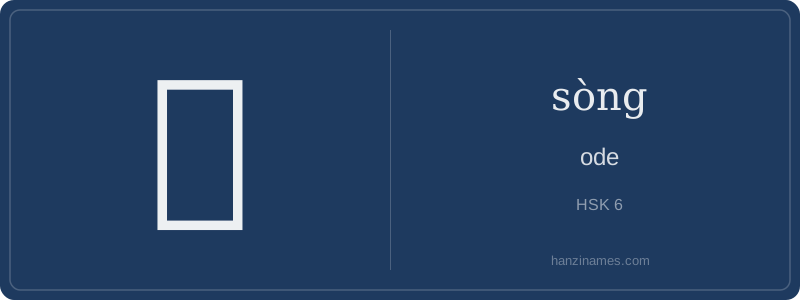
In modern Chinese, 颂 appears primarily in formal, literary, or political contexts: ‘歌颂’ (gēsòng, ‘to sing praises of’) is ubiquitous in state media, school textbooks, and commemorative speeches—e.g., ‘歌颂祖国’ (‘sing praises of the motherland’). It also appears in classical compound words like ‘颂词’ (sòngcí, ‘eulogy’) delivered at funerals or award ceremonies. Historically, it formed one of the three divisions of the *Shījīng*, alongside ‘fēng’ (airs) and ‘yǎ’ (elegances).
The character’s seal-script form (c. 3rd c. BCE) clearly combines 公 (public authority) and 页 (head/ritual visage), reflecting its origin in ancestral worship. No oracle bone form survives, but bronze inscriptions confirm its use by the 9th century BCE for royal eulogies—making it one of the oldest attested characters for formalized praise.
As an archaeologist brushing dust from a Han dynasty bamboo slip, I find 颂 inscribed in elegant clerical script—not as mere praise, but as ritual incantation. Its earliest attested use appears in the *Book of Songs* (*Shījīng*), where ‘sòng’ designated the ‘Odes’ section: solemn hymns performed at ancestral temples. This wasn’t casual flattery—it was liturgical speech, chanted with bronze bells and stone chimes, binding cosmos and kinship.
The character’s structure reveals its sacred weight: left side ‘公’ (gōng, public/ducal) fused with right side ‘页’ (yè, head/face)—not just ‘praising a person,’ but publicly honoring the ancestral face before heaven. In excavated Western Zhou bronze inscriptions, 颂 appears in contexts like ‘颂其先祖’ (‘sing praises of their forebears’), always linked to lineage legitimacy and divine sanction.
Modern excavation of linguistic layers shows 颂 resisted colloquial erosion: unlike synonyms like 赞 (zàn), it retains ceremonial gravity. Even today, official commemorations—like the 2019 ‘70th Anniversary of the PRC Ode’—use 颂 deliberately, echoing Bronze Age resonance. It’s a fossilized verb: not ‘to praise,’ but ‘to ritually affirm continuity.’ To write 颂 is to reenact an ancient act of cosmic alignment—stroke by stroke, breath by breath.
Example Sentences
Common Compounds
Similar Characters — Don't Mix These Up
Your First Step into Chinese Culture: Get a Chinese Name
Every journey into Chinese begins with a name. Use our free Chinese name generator to create a meaningful, personalized Chinese name that fits you perfectly.
Get My Chinese Name →