驻
Character Story & Explanation
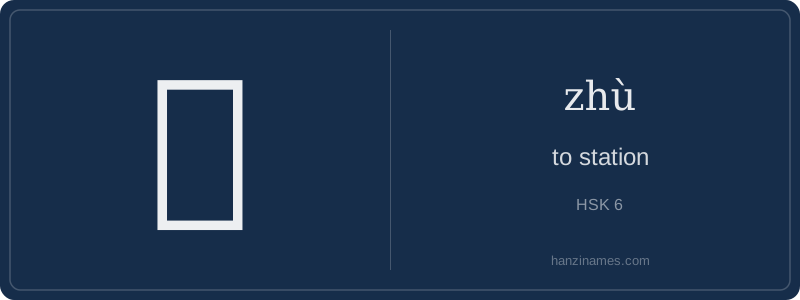
In daily life, 驻 appears in official signage, news headlines, and government documents—most commonly in compounds like 驻华使馆 (zhù huá shǐguǎn, 'embassy accredited to China') or 驻村干部 (zhù cūn gānbu, 'village-resident cadre', a key poverty-alleviation role introduced nationwide since 2015). The State Council’s 2021 report on rural revitalization documented over 3 million such cadres 'stationed' in villages—making 驻 a cornerstone term in contemporary policy discourse. It also appears in idioms like 驻颜有术 (zhù yán yǒu shù, 'skilled at preserving one’s youthful appearance'), where it retains its core sense of 'halting' or 'arresting change'.
The character is not pictographic; it’s a standardized seal-script-derived compound. Its left side 马 (mǎ, 'horse') is the radical, historically linking it to mobility and military deployment (e.g., ancient garrisons). The right side 主 (zhǔ, 'master; host') was adopted phonetically and semantically—indicating authoritative, settled presence. No oracle bone or bronze inscription evidence exists for 驻; it emerged fully formed in clerical script during the Han dynasty as a functional administrative term.
Imagine standing at Beijing West Railway Station on a crisp autumn morning. A high-speed train labeled G102 glides silently into Platform 3—and then, precisely at 8:15 a.m., it halts. Not just stops, but pauses deliberately: doors open, passengers board, staff verify tickets. This controlled, purposeful pause is exactly what 驻 (zhù) conveys—not a sudden brake or accidental stop, but an intentional, sustained halt with presence and function. It’s the verb for institutional stillness: a diplomat stationed abroad, troops deployed to a border post, or a liaison office established in another city.
The character’s eight strokes flow from left to right: first the ‘horse’ radical (马), suggesting mobility and movement—then the right side 主 (zhǔ), meaning ‘master’ or ‘host’, implying authority over a location. Together, they form a semantic-phonetic compound: the horse sets the domain (movement-related contexts), while 主 provides both sound (zhǔ → zhù via tone shift) and meaning (a master taking charge of a place). This duality captures the essence of ‘stationing’—not passive stopping, but active, authoritative presence.
In modern usage, 驻 carries weight and formality. You won’t use it for your bike leaning against a lamppost—that’s 停 (tíng). But when the Chinese Embassy resides in Washington, D.C., or a tech firm establishes a R&D center in Shenzhen, 驻 is the precise, official term. Its HSK Level 6 status reflects its abstract, bureaucratic nuance—mastering it signals fluency in formal, administrative, and diplomatic Chinese, where intention and institutional continuity matter more than mere physical cessation.
Example Sentences
Common Compounds
Similar Characters — Don't Mix These Up
Your First Step into Chinese Culture: Get a Chinese Name
Every journey into Chinese begins with a name. Use our free Chinese name generator to create a meaningful, personalized Chinese name that fits you perfectly.
Get My Chinese Name →