魄
Character Story & Explanation
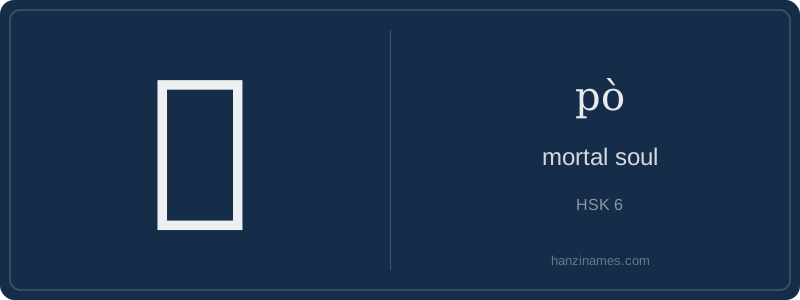
In daily usage, 魄 appears most frequently in compound words denoting inner strength or presence—e.g., 胆魄 (dǎn pò, 'courage and boldness') and 气魄 (qì pò, 'magnificent bearing'). It features prominently in political rhetoric (e.g., 'a leader with great qì pò') and literary criticism ('a poem with striking pò'). Historically, the Rites of Zhou and Han dynasty medical texts explicitly distinguish pò as the 'yin soul' linked to the kidneys and breath, departing the body within seven days after death—a belief influencing funeral customs and tomb inscriptions.
The character’s form combines 鬼 (guǐ, 'ghost')—its semantic radical—with 白 (bái, 'white'), likely serving as a phonetic component (though pronunciation diverged over time). No oracle-bone or bronze script forms survive; earliest attested use is in Warring States bamboo slips (c. 4th century BCE), where it consistently denotes the corporeal soul. Today, Chinese people encounter it in idioms like 魄散魂飞 (pò sàn hún fēi, 'soul scattered, spirit flown')—describing utter terror.
魄 (pò) embodies a foundational concept in traditional Chinese cosmology: the mortal, yin-dominant aspect of the human soul that dissolves after death. Unlike the immortal, heavenly hún (魂), the pò is tethered to the physical body, governing instincts, breath, and bodily functions. Ancient texts like the Huainanzi and medical classics describe it as residing in the lungs and descending with the breath at death—reflecting a worldview where life force is material, cyclical, and inseparable from physiology.
This duality—hún and pò—reveals a non-dualistic yet deeply structured understanding of personhood: not a singular 'soul' but a dynamic pair, each with distinct origins, trajectories, and moral weight. The pò’s association with the radical 鬼 (guǐ, 'ghost') underscores its liminal status—not evil, but the raw, unrefined essence that lingers near graves or manifests in nocturnal fears, later ritualized in ancestral rites to pacify and honor it.
Modern usage preserves this metaphysical gravity while adapting to psychological and aesthetic domains: 'courage' (胆魄) or 'magnetic presence' (气魄) extend pò’s meaning into embodied charisma and visceral resolve. This semantic expansion reflects how classical cosmology continues to animate contemporary language—not as superstition, but as a living grammar for expressing inner vitality, moral fortitude, and the tangible weight of human spirit.
Example Sentences
Common Compounds
Similar Characters — Don't Mix These Up
Your First Step into Chinese Culture: Get a Chinese Name
Every journey into Chinese begins with a name. Use our free Chinese name generator to create a meaningful, personalized Chinese name that fits you perfectly.
Get My Chinese Name →