魔
Character Story & Explanation
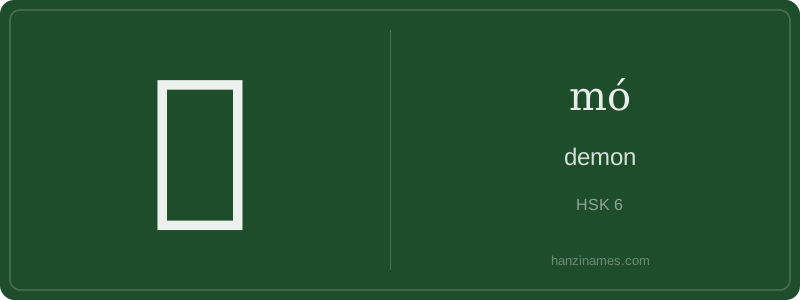
In modern Chinese, 魔 appears widely—not just in religious or literary contexts, but in everyday metaphors: ‘workaholic’ becomes 工作狂 (gōngzuò kuáng) or colloquially 工作魔 (gōngzuò mó); ‘gaming addict’ may be called 游戏魔 (yóuxì mó). The idiom 魔高一尺,道高一丈 (mó gāo yī chǐ, dào gāo yī zhàng)—‘as the demon rises one foot, the Dao rises ten’—is cited in political speeches and self-help literature to express resilience against adversity.
The character’s form has no oracle-bone attestation; it first appears in Han dynasty (206 BCE–220 CE) texts as a Buddhist loan character. Its structure is reliably phonosemantic: 鬼 (ghost/spirit) + 麻 (phonetic and semantic echo of chaos), not a pictograph. Today, Chinese learners practice it in HSK 6 writing drills for its complex stroke order and cultural weight.
As a detective tracing 魔’s evolution, I begin at its radical: 鬼 (guǐ), meaning 'ghost' or 'spirit'—a pictograph originally depicting a kneeling figure with a grotesque head, used since Oracle Bone Script (c. 1200 BCE) to denote supernatural beings. This radical anchors 魔’s core semantic field: entities beyond human control, often malevolent.
The right side, 麻 (má), is phonetic—pronounced similarly to mó in Middle Chinese (though modern má differs). Crucially, 麻 also carried connotations of entanglement and confusion (e.g., 麻烦 ‘trouble’), subtly reinforcing the idea of spiritual bewilderment or moral ensnarement. This phonosemantic pairing wasn’t arbitrary: it fused sound with layered meaning.
Historically, 魔 entered Chinese via Buddhist translation in the 2nd–3rd centuries CE, rendering Sanskrit *māra*—the personification of temptation, death, and illusion who besieged the Buddha under the Bodhi tree. Unlike native Chinese ghosts, 魔 implied active deception and existential threat, reshaping Daoist and folk understandings of spiritual danger.
Example Sentences
Common Compounds
Similar Characters — Don't Mix These Up
Your First Step into Chinese Culture: Get a Chinese Name
Every journey into Chinese begins with a name. Use our free Chinese name generator to create a meaningful, personalized Chinese name that fits you perfectly.
Get My Chinese Name →