黎
Character Story & Explanation
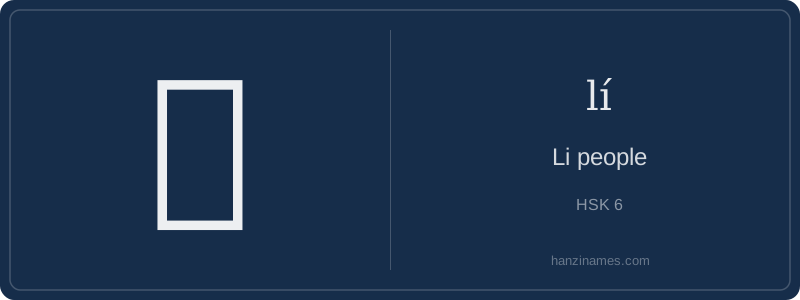
黎 is most commonly encountered today in official and academic contexts referring to the Li people: e.g., in government documents (‘Li Autonomous Counties’), museum exhibits (‘Li textile heritage’), and university courses on minority cultures. It appears in the standardized compound 黎族 (Lízú), meaning ‘Li ethnic group’, and is featured in the national intangible cultural heritage list for Li brocade (黎锦, Líjǐn), inscribed by UNESCO in 2009.
The character’s form combines the radical 黍 (millet, symbolizing agriculture) with 禾 (grain) and 水 (water) elements — reflecting ancient associations with fertile lowland farming communities. Though not a pictograph, its structure aligns with Shuowen Jiezi (121 CE) description as ‘black-haired people of the south’, later applied administratively to Hainan’s indigenous groups.
The Chinese character 黎 (lí) is a Level 6 HSK character with 15 strokes and the radical 黍 (shǔ), meaning 'millet'. While historically associated with dawn or black hair in classical texts, its dominant modern usage refers specifically to the Li ethnic group — one of China’s 56 officially recognized nationalities, indigenous to Hainan Island. This semantic shift reflects how political recognition and ethnographic classification have reshaped character usage in contemporary Mandarin.
Unlike Western ethnic labels (e.g., ‘Celtic’, ‘Inuit’), which often derive from self-designation or geographic origin, 黎 is an exonym assigned by Han Chinese administration during the Yuan–Ming dynasties and formalized in the 20th century. It carries no inherent phonetic or semantic link to the Li people’s own language (Hlai), where they call themselves *Bouyei* or *Haony*. The character thus functions more as a bureaucratic category than a linguistic echo.
In cross-cultural comparison, 黎 resembles terms like ‘Navajo’ (a Spanish adaptation of the Tewa word *nawóóji*) or ‘Eskimo’ (a colonial Algonquian term now largely replaced by Inuktitut *Inuit*). Like these, 黎 is widely used in official contexts — census data, education policy, cultural preservation programs — yet remains linguistically detached from native identity. Its continued use underscores China’s centralized ethnic classification system, distinct from Western models emphasizing self-identification or sovereignty-based recognition.
Example Sentences
Common Compounds
Similar Characters — Don't Mix These Up
Your First Step into Chinese Culture: Get a Chinese Name
Every journey into Chinese begins with a name. Use our free Chinese name generator to create a meaningful, personalized Chinese name that fits you perfectly.
Get My Chinese Name →