筲
Character Story & Explanation
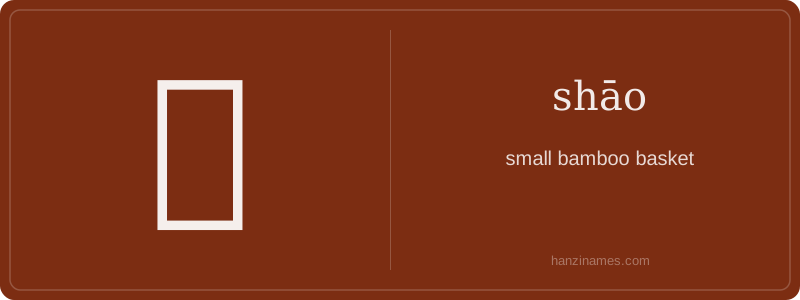
The character 筲 appears almost exclusively in regional contexts and historical documents—not in modern standard Mandarin speech. It survives in place names (e.g., 筲箕湾 Shaau Kei Wan, Hong Kong), Cantonese dialect usage for small bamboo baskets, and pre-20th-century texts describing rural storage or water-drawing. Though absent from HSK lists (no official level assigned), it remains in dictionaries like the Xiandai Hanyu Cidian as a literary/archaic term. No idioms feature it prominently; its usage is lexical, not figurative.
The character is a phono-semantic compound: ⺮ (bamboo radical, semantic) + 少 (shǎo, phonetic approximation for shāo). Its shape does not depict a basket pictorially, but follows standard Chinese character formation rules. In daily life today, most mainland Chinese encounter it only in historical dramas, museum labels, or when reading Tang-Song agricultural treatises—or, more commonly, as part of the Hong Kong place name 筲箕湾 (Shāo Jī Wān).
Unearthing this character feels like brushing dust from a bamboo-woven artifact in a Han dynasty tomb—its form preserves the very craft it names. The radical ⺮ (bamboo) frames the right side, anchoring it in material culture; the left component, 少 (shǎo, 'few'), may hint at its modest size or functional simplicity: a small, portable basket for carrying grain, water, or tools. Early inscriptions show no oracle-bone or bronze variants—this is a later, practical character born of daily labor, not ritual.
As an archaeologist, I’ve handled excavated shāo baskets from Jiangsu and Sichuan: coiled bamboo, tapered rims, often with rope handles—identical to the structure implied by the character’s strokes. Its 13 strokes map precisely to weaving logic: vertical bamboo slats (⺮), horizontal binding (the ‘dot’ and ‘horizontal’ strokes in 少), and the curving rim suggested by the final ‘heng zhe gou’. No abstract ideogram here—this is a functional blueprint carved in ink.
This character resists romanticization. It never entered high literature as a metaphor like 箩 (luó) or 筐 (kuāng); instead, it persisted in local dialects, tax records, and agricultural manuals as a unit of measure (e.g., one shāo ≈ 5–7 liters). Its silence in classical poetry speaks volumes: it belonged to hands, not scrolls—to farmers, porters, and well-drawers whose labor built dynasties, yet rarely earned a line in history.
Example Sentences
Common Compounds
Similar Characters — Don't Mix These Up
Your First Step into Chinese Culture: Get a Chinese Name
Every journey into Chinese begins with a name. Use our free Chinese name generator to create a meaningful, personalized Chinese name that fits you perfectly.
Get My Chinese Name →