丌
Character Story & Explanation
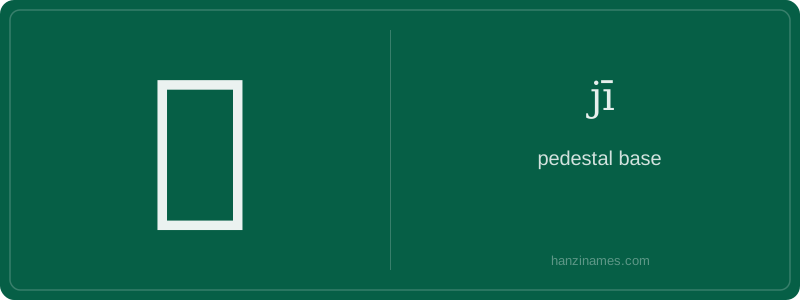
丌 is virtually unused in contemporary spoken or written Mandarin. It does not appear in any HSK vocabulary list, modern dictionaries as an independent entry, or common idioms. No standard phrases, slogans, or digital text contain 丌 as a lexical item. Its presence is exclusively historical and orthographic—visible only in paleographic studies, calligraphy manuals, or as a subcomponent in characters like 其 and 甚. Linguists reference it when analyzing the evolution of Chinese script, but ordinary speakers neither read nor write it.
The character’s earliest documented form appears in seal script (pre-Qin to Han dynasty), where it clearly depicts a simple two-tiered base: two parallel horizontals framing a central vertical—functionally identical to a minimalist plinth. There is no oracle bone inscription evidence for 丌; its attested use begins in bronze inscriptions and small seal script as a semantic indicator for ‘supporting base’.
The character 丌 (jī) is a rare, archaic component in Chinese writing—not used independently in modern Mandarin but preserved as a structural element in compound characters. Historically, it represented a low platform or pedestal—literally a raised base for holding ritual objects. Though obsolete as a standalone word, it survives in the etymology of characters like 其 (qí, 'its') and 甚 (shèn, 'very'), where its shape reflects an ancient pictographic base supporting something above.
In traditional lexicography, 丌 appears in Shuōwén Jiězì (121 CE), China’s first systematic dictionary, classified under Radical 一 (yī, 'one') due to its horizontal stroke structure. Its three-stroke form—horizontal, vertical, horizontal—mirrors the simplicity of foundational architectural forms: flat ground, upright support, and capped surface. This geometric minimalism anticipates modern design principles like functional clarity and visual balance.
Western equivalents include the Greek 'bema' (a raised platform for speakers or judges), the Roman 'podium', or the Christian 'altar step'—all signifying elevation with symbolic weight. Unlike these culturally specific terms, 丌 lacks religious or political connotations; it’s purely functional and neutral, reflecting early Chinese emphasis on practicality and structural harmony over hierarchy or ceremony.
Example Sentences
Common Compounds
Similar Characters — Don't Mix These Up
Your First Step into Chinese Culture: Get a Chinese Name
Every journey into Chinese begins with a name. Use our free Chinese name generator to create a meaningful, personalized Chinese name that fits you perfectly.
Get My Chinese Name →