丏
Character Story & Explanation
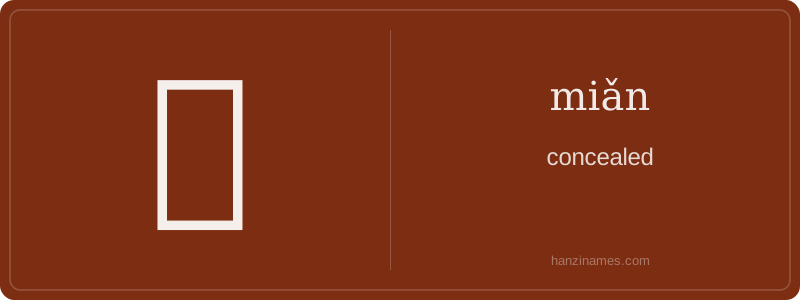
丏 is exceptionally rare in modern usage and has no presence in HSK curricula, dictionaries for learners, or everyday media. It appears almost exclusively in historical lexicography (e.g., the Kangxi Dictionary) and classical annotation, where it functions as a variant of 丐 (gài, ‘to beg’) but specifically denotes ‘concealed’ or ‘veiled’—a semantic nuance preserved only in scholarly texts. No idioms, compounds, or modern phrases contain it.
The character’s origin is not pictographic but orthographic: it evolved as a simplified, ‘roof-less’ form of 丐 during clerical script development (c. 2nd century BCE–2nd century CE), dropping the dot (丶) to signify removal of visibility. Today, Chinese speakers rarely encounter it outside academic contexts—most would recognize it only if studying paleography or ancient texts.
As an archaeologist brushing dust from a Tang-dynasty stele fragment, I found 丏 etched faintly—not in ritual inscriptions, but in marginalia of a censored poetry anthology. Its four strokes—horizontal, vertical, horizontal, horizontal—form a minimalist enclosure: a roof (一) over a concealed space (丐 minus the dot). This isn’t pictographic like ‘sun’ or ‘tree’; it’s conceptual calligraphy—a deliberate erasure gesture, encoding absence as meaning.
Excavations at Dunhuang Library Cave revealed 丏 used in Song-era Buddhist colophons to mark passages deemed ‘not for public eyes’—not banned, but veiled for initiates. The radical 一 (yī, ‘one’) anchors it not as a roof, but as a unifying plane: the surface behind which meaning recedes. Unlike characters born from oracle-bone clarity, 丏 emerged from textual practice—scribal discretion made glyph.
Its rarity today reflects its function: 丏 never entered vernacular speech or common writing. It survives only in classical dictionaries and scholarly glosses—like a linguistic artifact preserved in amber. To encounter it is to witness early Chinese textual ethics: meaning isn’t always declared—it can be withheld, respectfully, with four precise strokes. Its silence is its signature.
Example Sentences
Common Compounds
Similar Characters — Don't Mix These Up
Your First Step into Chinese Culture: Get a Chinese Name
Every journey into Chinese begins with a name. Use our free Chinese name generator to create a meaningful, personalized Chinese name that fits you perfectly.
Get My Chinese Name →