丫
Character Story & Explanation
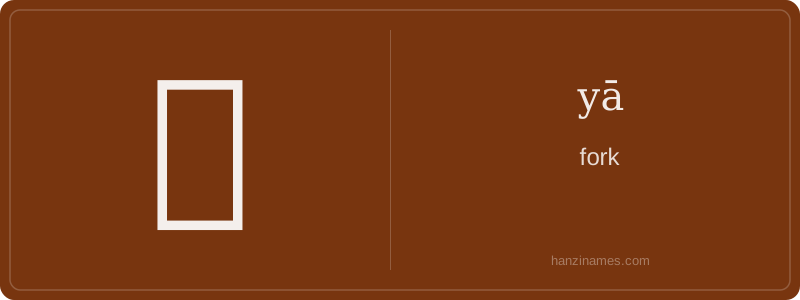
In contemporary China, 丫 is most commonly used in affectionate nicknames like 小丫 (xiǎo yā) for young girls—especially in northern regions such as Hebei and Shandong—and appears in informal writing, social media, and dialect literature. It also survives in fixed terms like 丫髻 (yā jì), an ancient hairstyle where hair was tied in two buns resembling forks, documented in Ming-Qing dynasty texts and still depicted in traditional opera costumes.
The character’s form is a clear pictograph: the vertical stroke (丨) represents a central stem or trunk, while the two diagonal strokes branching upward mimic a forked structure—like a tree limb splitting, a road diverging, or hair parted into two buns. This visual logic is consistently attested in dictionaries from the Kangxi era onward and remains unchanged in modern standard script.
The character 丫 (yā) is a deceptively simple yet culturally rich glyph—just three strokes forming a symmetrical 'Y' shape. Though its literal meaning is 'fork' or 'bifurcation', it rarely appears alone in modern written Chinese. Instead, it thrives in colloquial speech and affectionate nicknames, especially in northern dialects. Its visual form evokes the image of a split path, a pair of horns, or even a child’s twin braids—making it a natural fit for terms of endearment.
Historically, 丫 entered Chinese writing as a variant of 丄 (an ancient form of 上, 'up'), but by the Song dynasty, it had stabilized as a standalone character meaning 'forked shape'. It appears in technical contexts like cartography ('fork in a road') and botany ('forked branch'), though such usage is now rare. Today, its vitality lies almost entirely in spoken language and informal writing—particularly in regional expressions and diminutive names.
What makes 丫 distinctive is its phonetic and semantic duality: it sounds identical to 呀 (yā), an interjection used for emphasis or surprise, creating playful homophonic wordplay. In Beijing hutong alleys or Shandong countryside villages, elders still call little girls '小丫' (xiǎo yā) — not because they resemble forks, but because the soft, doubled syllable conveys warmth and familiarity. This emotional resonance outweighs its dictionary definition, turning a geometric symbol into a cultural shorthand for youth and intimacy.
Example Sentences
Common Compounds
Similar Characters — Don't Mix These Up
Your First Step into Chinese Culture: Get a Chinese Name
Every journey into Chinese begins with a name. Use our free Chinese name generator to create a meaningful, personalized Chinese name that fits you perfectly.
Get My Chinese Name →