丮
Character Story & Explanation
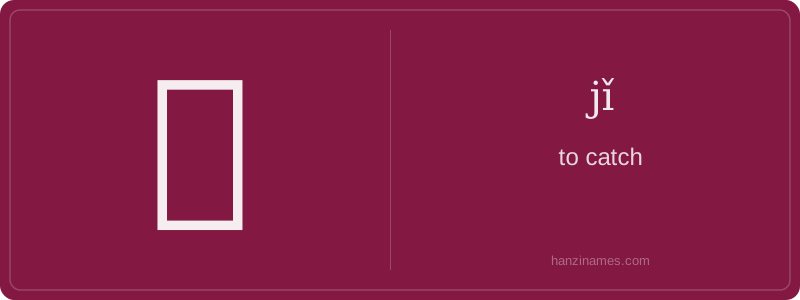
丮 does not appear in modern spoken or written Mandarin outside specialized academic, paleographic, or lexicographic contexts. It is absent from all HSK vocabulary lists, contemporary newspapers, and digital input methods. The character is documented in ancient dictionaries like the Shuōwén Jiězì (c. 100 CE), where it’s defined as 'to hold with both hands' and classified under the 'hand' radical. No idioms, phrases, or proper names in standard modern usage include 丮 as an independent character.
The form of 丮 is widely accepted by scholars as a stylized pictograph of two hands ( + ) converging on a central point — representing grasping. Its earliest attested form appears in bronze inscriptions of the Western Zhou dynasty (1046–771 BCE), not oracle bones. In teaching today, it’s used only to illustrate historical morphology — never in communication.
Hi students! Today we’re looking at the character 丮 (jǐ), a rare and ancient form that means 'to catch' or 'to grasp with both hands'. Though it looks simple — just three strokes forming a hand-like shape — it’s not used in modern daily Chinese. Instead, it’s mostly found in classical texts, dictionaries, or as part of more complex characters. Don’t worry if it feels unfamiliar: even native speakers rarely write or read it alone.
This character is a great example of how Chinese evolved from pictographic roots. Its shape resembles two hands reaching toward an object — a visual echo of its meaning. While today we use common verbs like 抓 (zhuā) or 捉 (zhuō) for 'to catch', 丮 preserves an older, more ceremonial sense of seizing or holding firmly, often in ritual or authoritative contexts.
As a beginner, your main goal isn’t to memorize 丮 for conversation — it’s to recognize how ancient forms inform modern ones. Many contemporary characters (like 具, jù — 'tool' or 'to have') contain 丮 as a component, revealing historical layers of meaning. Think of 丮 as a linguistic fossil: small, silent, but rich with insight into how Chinese writing developed over 3,000 years.
Example Sentences
Common Compounds
Similar Characters — Don't Mix These Up
Your First Step into Chinese Culture: Get a Chinese Name
Every journey into Chinese begins with a name. Use our free Chinese name generator to create a meaningful, personalized Chinese name that fits you perfectly.
Get My Chinese Name →