丱
Character Story & Explanation
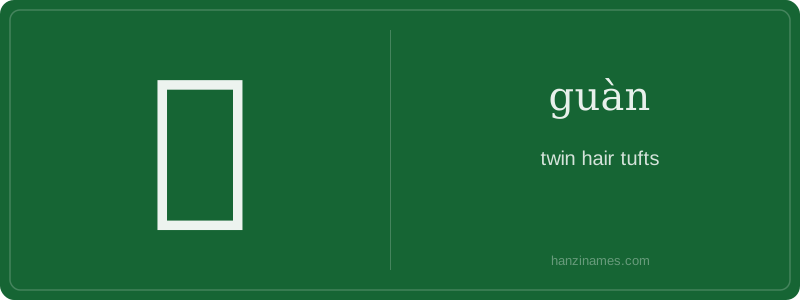
丱 is virtually unused in contemporary spoken or written Mandarin outside classical allusions, poetry, or scholarly contexts. It appears in historical texts like the *Book of Rites* (Liji) describing children’s hairstyles before capping ceremonies, and occasionally in Tang-Song poetry (e.g., Li He’s verses) evoking youthful purity. No idioms or modern compounds contain it; it has no presence in HSK lists or everyday media.
The character is a clear pictograph: its shape directly mirrors the traditional hairstyle — two symmetrical upward tufts (the outer strokes) rising from a child’s parted hairline (the central 丨), with the small horizontal strokes representing binding cords. This origin is documented in Xu Shen’s *Shuowen Jiezi*, which defines 丱 as ‘a child’s hair tied in two bunches’ — a rare case where form, meaning, and historical usage align without ambiguity.
Our detective begins at the crime scene: the character 丱. At first glance, it looks like two vertical strokes flanking a central one — not unlike twin hairpins holding up braids. But this isn’t ornamentation; it’s a precise ancient shorthand. In early Chinese script, especially in clerical and seal forms, 丱 emerged as a stylized depiction of a child’s hairstyle — two upward-pointing tufts, symmetrically bound on either side of the forehead, a universal marker of pre-adolescence in Zhou to Han dynasty rites.
Zooming in with paleographic tools, we find no oracle bone or bronze inscriptions bearing 丱 — it appears later, solidifying in the *Shuowen Jiezi* (121 CE) as a ‘child’s topknot’ character under the radical 丨 (gǔn, ‘vertical line’), which here acts less as semantic anchor and more as structural spine. The five strokes aren’t arbitrary: the two outer strokes represent the tufts; the middle vertical is the scalp’s centerline; the two short horizontals (often written as dots or tiny hooks in cursive) mark the ties or knots — a minimalist portrait carved in ink and intention.
Our detective notes an important twist: 丱 never evolved into a functional grammatical particle or common verb. Instead, it fossilized as a literary and ceremonial glyph — preserved not in markets or letters, but in poetry, ritual texts, and historical glossaries. Its survival isn’t due to utility, but to cultural resonance: a visual metonym for childhood innocence, fleeting and formalized. That’s why modern dictionaries list it as ‘rare’ and ‘archaic’ — not obsolete, but enshrined, like a lacquered hairpin in a museum drawer.
Example Sentences
Common Compounds
Similar Characters — Don't Mix These Up
Your First Step into Chinese Culture: Get a Chinese Name
Every journey into Chinese begins with a name. Use our free Chinese name generator to create a meaningful, personalized Chinese name that fits you perfectly.
Get My Chinese Name →