丳
Character Story & Explanation
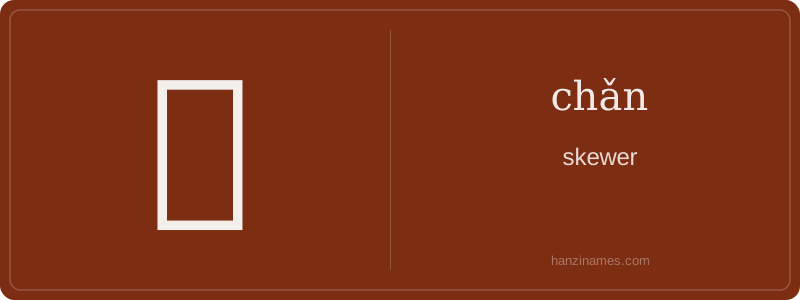
丳 (chǎn) is virtually obsolete in contemporary Mandarin usage. It appears only in historical dictionaries (e.g., Kangxi Dictionary, entry #75 under radical 丿) and specialized texts on ancient cooking methods. No modern HSK word lists, textbooks, or digital corpora (e.g., BCC, COCA-Chinese) include it. It is absent from all six HSK levels and carries no frequency ranking in the Modern Chinese Corpus. Today, speakers use 签 (qiān) or 竹签 (zhúqiān) for 'skewer'—not 丳.
The character is a pictograph: its three horizontal strokes represent meat slices, pierced vertically by a single stroke—depicting a skewer impaling food. This structure is documented in the Shuōwén Jiězì (c. 100 CE) as a ‘tool-character’ (qìzì), not a semantic-phonetic compound. Though rarely handwritten today, chefs in northwestern China occasionally inscribe 丳 on vintage-style barbecue signage to evoke authenticity.
The character 丳 (chǎn) is a rare, functional glyph that embodies the Chinese worldview’s reverence for practical tools as cultural anchors. Unlike abstract philosophical characters, 丳 is grounded in embodied experience—roasting meat over fire, sharing food, celebrating harvests. Its very existence reflects how Chinese civilization elevates everyday implements into symbols of community, hospitality, and ritual continuity. A skewer isn’t just metal or bamboo; it’s a bridge between raw and cooked, individual and collective, labor and feast.
In traditional Chinese cosmology, tools like 丳 subtly mirror the principle of ‘yīn-yáng interdependence’: the skewer (yang—firm, penetrating) holds the food (yin—soft, receptive), enabling transformation through heat—the third vital force. This triadic relationship echoes broader patterns: the tool enables process, the process yields nourishment, and nourishment sustains human connection. Thus, 丳 quietly encodes a worldview where utility, harmony, and relational ethics are inseparable.
Though seldom seen in modern typography, 丳 appears in classical texts and regional culinary records as proof that language preserves material culture long after usage fades. Its survival reminds us that Chinese writing doesn’t merely describe reality—it curates it, selecting which objects deserve lexical immortality. A skewer may seem humble, but in preserving 丳, Chinese script honors the quiet dignity of craft, the centrality of shared meals, and the idea that civilization is forged not only in palaces and poems—but also over open flames, on sticks.
Example Sentences
Common Compounds
Similar Characters — Don't Mix These Up
Your First Step into Chinese Culture: Get a Chinese Name
Every journey into Chinese begins with a name. Use our free Chinese name generator to create a meaningful, personalized Chinese name that fits you perfectly.
Get My Chinese Name →