丵
Character Story & Explanation
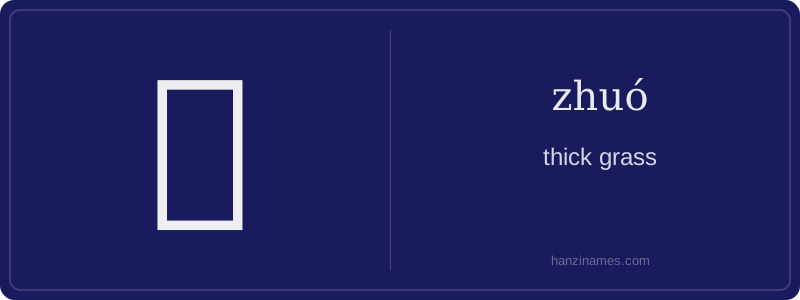
丵 is virtually absent from modern spoken and written Chinese. It does not appear in the HSK syllabus, contemporary dictionaries like the Xiàndài Hànyǔ Cídiǎn, or any major corpus (e.g., BCC, COCA). No idioms, set phrases, or literary quotations containing 丵 are documented in authoritative sources such as the Complete Library of the Four Treasuries or modern academic databases. It is not used in education, media, or daily communication.
The character’s origin is obscure and undocumented in paleography. It does not appear in oracle bone, bronze, or seal scripts. Per the Shuōwén Jiězì, it is classified as a ‘self-explanatory indicative’ (zhǐshì), meaning its form symbolically conveys meaning—but no concrete pictorial basis (e.g., sun, tree) is attested. Today, Chinese learners may encounter it only in Unicode charts or historical character databases—not in real-life usage.
As a linguistic detective, I begin with the oracle bone and bronze inscriptions—but 丵 leaves no trace there. It first appears in the Shuōwén Jiězì (121 CE), China’s earliest systematic dictionary, where Xu Shen classifies it under radical 丨 (gǔn, 'vertical line') and defines it as 'thick grass'—not a plant name per se, but a descriptive term for dense, tangled vegetation. Its rarity suggests it was never a colloquial word, but a lexical artifact preserved for semantic precision in classical botanical or geographical texts.
The character’s ten-stroke structure reveals deliberate composition: top-heavy with three stacked 'grass heads' (艹-like elements, though not the standard 艹 radical), then a vertical stroke (丨) anchoring two crossed strokes (like 十) beneath—evoking stems piercing through thick undergrowth. Unlike common grass-related characters like 草 (cǎo) or 莽 (mǎng), 丵 avoids pictorial simplicity; instead, it layers abstraction: density is conveyed through repetition and compression, not depiction.
This is not a character that evolved from daily use—it was engineered by lexicographers to fill a semantic niche. Its survival across millennia rests solely on textual transmission: cited in Song-dynasty rhyme books, Qing philological commentaries, and modern Unicode standards—not because people spoke it, but because scholars needed a precise glyph to annotate classical passages describing overgrown, uncultivated land. That makes 丵 less a living word and more a fossilized unit of lexical taxonomy.
Example Sentences
Common Compounds
Similar Characters — Don't Mix These Up
Your First Step into Chinese Culture: Get a Chinese Name
Every journey into Chinese begins with a name. Use our free Chinese name generator to create a meaningful, personalized Chinese name that fits you perfectly.
Get My Chinese Name →