丶
Character Story & Explanation
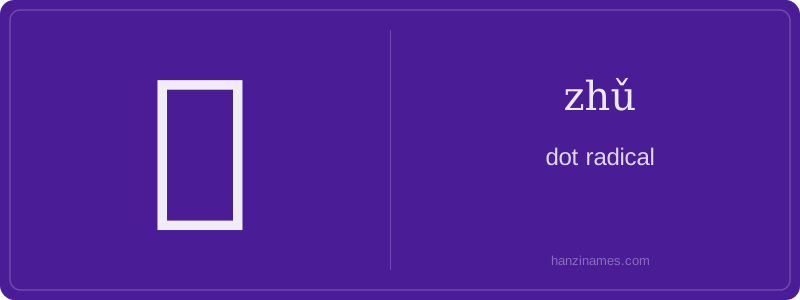
In modern China, 丶 is rarely used alone—but it’s indispensable behind the scenes. It’s the first radical in the Kangxi Dictionary and appears in everyday characters like 点 (diǎn, 'dot/point'), 炎 (yán, 'flame'), and 求 (qiú, 'to seek'). The phrase 画龙点睛 (huà lóng diǎn jīng, 'to dot the eyes when painting a dragon')—a famous idiom meaning 'the finishing touch that brings something to life'—relies on this radical’s conceptual weight: that one small dot can animate the whole. Dictionaries, handwriting apps, and elementary textbooks all highlight 丶 as the 'dot radical' to teach component awareness.
丶 has no pictographic origin—it wasn’t drawn from nature like 日 (sun) or 山 (mountain). Instead, scholars agree it developed as a stylized, functional stroke in clerical script (lìshū), likely evolving from a short, detached ‘ending stroke’ used to distinguish similar forms. Today, Chinese students learn it in Grade 1 calligraphy drills: one clean, slightly rounded dot, written in a single motion—never lifted, never retraced—emphasizing precision and intention.
The character 丶 (zhǔ) is not a standalone word in modern Mandarin but a foundational radical—known as the 'dot' or 'dian' radical—used in over 200 Chinese characters. Though it looks like a simple dot, its placement is precise: always written as a downward-right stroke starting from the top-left, ending with slight pressure. In traditional lexicography, it’s Radical 3 (in Kangxi Dictionary), governing characters like 主 (zhǔ, 'master'), 丸 (wán, 'pellet'), and 丹 (dān, 'cinnabar'). Its minimalism belies its structural importance—it often signals semantic or phonetic roles in complex characters.
Historically, 丶 evolved from an ancient indicator mark, not a pictograph of an object. Unlike sun (日) or tree (木), it never represented a physical thing; instead, it functioned as a diacritical or positional marker in early seal script. Over time, it stabilized into a standardized dot radical used for classification and indexing. Calligraphers treat it with care—it must be round, firm, and balanced, never too flat or too long—reflecting its role as a visual anchor in many characters.
In contemporary usage, learners encounter 丶 primarily through dictionaries and handwriting practice—not as a word to speak, but as a key to unlocking character structure. It appears in HSK-level characters like 点 (diǎn, 'point') and 热 (rè, 'hot'), where its presence helps categorize and locate them in reference tools. Though rarely pronounced 'zhǔ' outside scholarly contexts, that reading survives in classical texts and linguistic terminology. Recognizing 丶 builds foundational literacy: it trains the eye to see components, not just strokes—essential for mastering thousands of characters efficiently.
Example Sentences
Common Compounds
Similar Characters — Don't Mix These Up
Your First Step into Chinese Culture: Get a Chinese Name
Every journey into Chinese begins with a name. Use our free Chinese name generator to create a meaningful, personalized Chinese name that fits you perfectly.
Get My Chinese Name →