丷
Character Story & Explanation
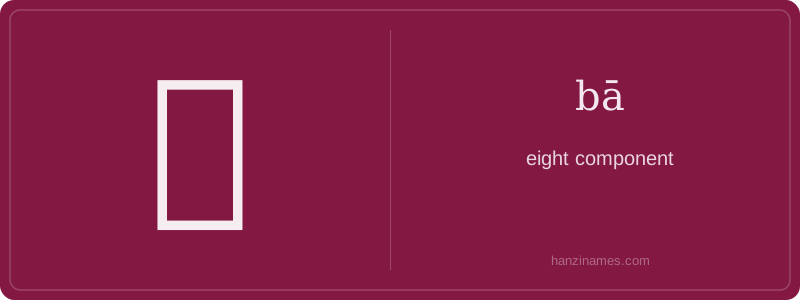
丷 is never used independently in modern Mandarin — it appears exclusively as a component in over 100 standardized Chinese characters, including high-frequency ones like 六 (liù, 'six'), 光 (guāng, 'light'), and 兴 (xīng, 'to rise'). It’s listed as Kangxi Radical 9 ('eight') and remains central to dictionary indexing. You’ll encounter it daily in printed text, handwriting, and digital input methods — especially when typing characters that begin with this shape.
The form 丷 is a cursive, top-position variant of 八 (bā, 'eight'), documented in seal script and standardized in the Kangxi Dictionary (1716). Unlike the full 八 — which is a pictograph of two diverging lines symbolizing 'separation' or 'distribution' — 丷 is a positional adaptation: when placed atop other components, the original 八 was compressed and rotated for balance and clarity, resulting in today’s two-stroke radical.
Hi there! Let’s talk about the character 丷 — it’s not a standalone word you’ll use in conversation, but it’s a vital building block in Chinese writing. Pronounced 'bā', it looks like two short strokes (a dot and a downward stroke) forming a 'V'-shaped component. Though it resembles the number 八 (bā, 'eight'), 丷 is actually a *radical* — a structural unit that appears at the top of many characters, such as 光 (guāng, 'light') and 六 (liù, 'six'). Think of it as a 'roof' or 'cover' shape that helps organize how characters are built and classified.
This component is officially listed as Radical 9 in dictionaries (the 'eight' radical), and while it shares its origin with 八, 丷 evolved as a simplified, stylized form used specifically in compound characters. It doesn’t carry independent meaning on its own — you won’t see it on price tags or street signs by itself — but it’s essential for recognizing and writing dozens of common characters correctly. Mastering its shape helps you understand character structure, not just memorize isolated forms.
As a beginner, don’t worry about using 丷 alone — instead, notice it whenever you see characters with a 'V' or 'inverted chevron' at the top. It’s a clue! For example, in 兴 (xīng, 'to rise; enthusiasm'), the top part is 丷 — helping signal this character’s connection to upward movement or activation. Learning radicals like 丷 builds your visual literacy, making new characters feel less random and more logical. With just two strokes, it’s one of the easiest to write — but one of the most meaningful to recognize.
Example Sentences
Common Compounds
Similar Characters — Don't Mix These Up
Your First Step into Chinese Culture: Get a Chinese Name
Every journey into Chinese begins with a name. Use our free Chinese name generator to create a meaningful, personalized Chinese name that fits you perfectly.
Get My Chinese Name →