乀
Character Story & Explanation
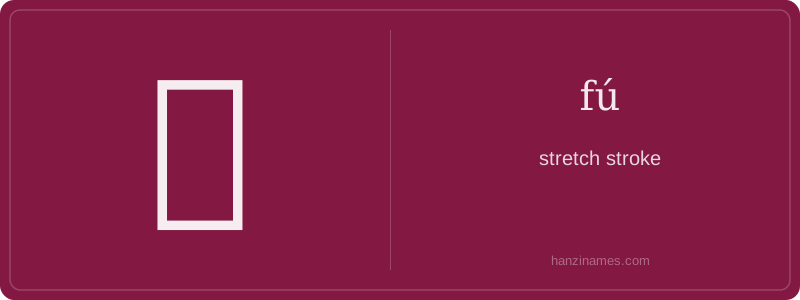
乀 is never used independently in modern Chinese writing, dictionaries, or official language standards (e.g., GB2312, Unicode CJK). It does not appear in any HSK vocabulary, textbooks, or government wordlists. You will not find it in idioms, names, or daily text—it is exclusively a stroke taught in calligraphy and handwriting instruction. Teachers demonstrate it using characters like 八 (bā, 'eight') or 人 (rén, 'person'), where 乀 forms the rightward-falling component.
Its origin is purely functional: it evolved from brush movement conventions in clerical script (lìshū) and regular script (kǎishū) as a standardized way to end or extend strokes with controlled momentum. No oracle bone or bronze inscription features 乀 alone—it only exists as part of larger characters. Today, Chinese students learn it in Grade 1 handwriting drills as 'nà' (捺) or 'piě' (撇) depending on angle and context, never as 'fú'.
The character 乀 is not an independent, commonly used Chinese character in modern Mandarin—it is a *stroke*, specifically the 'down-right falling stroke' (piě or sometimes classified as nà in certain contexts), not a standalone logograph. It appears as a component in many characters (e.g., 人, 八, 入) but has no lexical meaning or pronunciation of its own in standard usage. Confusion arises because some dictionaries or stroke-naming guides list it with the label 'fú' and gloss it as 'stretch', but this reflects a descriptive term for its shape and motion—not a semantic or phonetic value.
This stroke is fundamental to Chinese calligraphy and handwriting pedagogy: learners practice it as one of the 'Eight Principles of Yong' (永字八法), where each stroke in 永 symbolizes a distinct brush technique. The 乀 stroke mimics a graceful, outward stretch—like a limb extending or a branch curving downward and rightward—hence the interpretive gloss 'stretch'. Yet unlike alphabetic letters, it carries no phonemic or grammatical function on its own.
In Western cultural terms, 乀 resembles a calligraphic flourish rather than a letter or word—akin to the terminal flick in italic 'f' or the descender hook in cursive 'y', valued for aesthetics and rhythm, not meaning. It’s comparable to musical articulation marks (e.g., staccato dot or slur): essential to expression and form, but meaningless in isolation. Its 'stretch' quality evokes concepts like release, flow, or expansion—echoing Taoist ideas of natural movement—but this is interpretive, not linguistic.
Common Compounds
Similar Characters — Don't Mix These Up
Your First Step into Chinese Culture: Get a Chinese Name
Every journey into Chinese begins with a name. Use our free Chinese name generator to create a meaningful, personalized Chinese name that fits you perfectly.
Get My Chinese Name →