乂
Character Story & Explanation
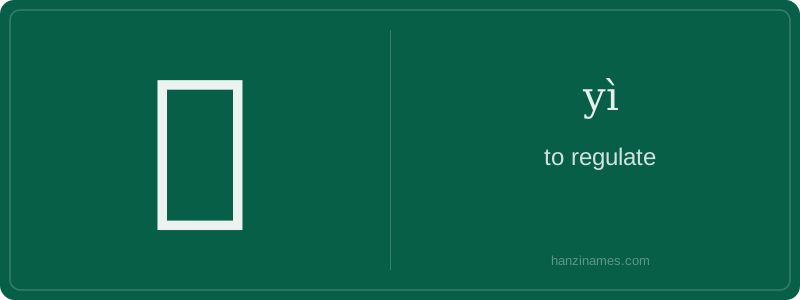
乂 appears in classical texts like the Shu Jing (Book of Documents), where it describes sage rulers who 'regulate the myriad states' (乂萬邦). It’s preserved in idioms like 安乂 (ān yì, 'peaceful governance') and in historical titles—e.g., Tang dynasty official Zhang Jiuling was praised for 'civilizing and regulating' (化乂). Today, it’s virtually absent from spoken language but appears in formal names, calligraphy, and academic discussions of pre-Qin political philosophy.
The character’s origin is not pictographic but likely evolved from oracle-bone script forms representing a 'cleaver' or 'cutting tool'—symbolizing decisive action to restore order. Modern scholars (e.g., Li Xiaoding, Oracle Bone Script Dictionary) note its early association with 'settling disputes' and 'pacifying unrest', confirming its regulatory semantics from the Shang–Zhou era onward.
The Chinese character 乂 (yì) is a deceptively simple yet historically weighty glyph—just two strokes, but carrying the profound meaning 'to regulate' or 'to govern'. Unlike common modern characters with frequent daily usage, 乂 is largely archaic and literary. Its minimalist form belies its role in classical texts as a verb denoting orderly management of affairs, people, or natural forces—akin to restoring balance after chaos.
In Confucian and Daoist thought, regulation wasn’t about control but harmonious alignment—much like a conductor guiding an orchestra without force. This resonates with Western philosophical ideals such as Plato’s 'just soul' (where reason regulates spirit and appetite) or Stoic self-mastery. Yet unlike English 'regulate', which often implies bureaucratic rules, 乂 connotes ethical, organic governance rooted in virtue and situational wisdom.
Though rarely used alone today, 乂 survives in compound words and classical allusions, serving as a semantic anchor for orderliness and competence. Its scarcity in spoken Mandarin contrasts sharply with its presence in historical inscriptions and elite discourse—making it a linguistic artifact of early Chinese statecraft. For learners, encountering 乂 offers a window into how ancient Chinese conceptualized authority not as domination, but as restorative, rhythmic stewardship.
Example Sentences
Common Compounds
Similar Characters — Don't Mix These Up
Your First Step into Chinese Culture: Get a Chinese Name
Every journey into Chinese begins with a name. Use our free Chinese name generator to create a meaningful, personalized Chinese name that fits you perfectly.
Get My Chinese Name →